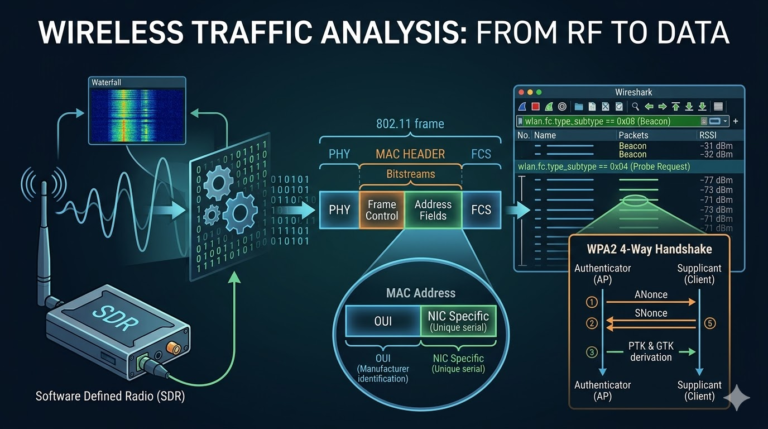
Jamming Dynamics and Spectrum Defence
 Eyüp Efe Aslan
What’s jamming ? Jamming is the act of blocking or disrupting a communication system’s operation by generating or transmitting noise or other signals within the radio frequency (RF) spectrum. This process can make it exceptionally difficult or entirely impossible for the targeted device or network to function properly.
Table of Contents
- Legal Disclaimer and Limitation of Liability
- Technical Terminology
- Technical Theory and Conceptual Framework
- Attack Detection and Defense Mechanisms
- Laboratory Simulation: Jamming and FHSS Defense with GNU Radio
- References

Chapter 1 : Legal Disclaimer and Limitation of Liability
All technical analyses and GNU Radio simulations detailed in this article were conducted strictly for educational and cybersecurity research purposes within an isolated laboratory environment.
- Electronic Communications Law No. 5809: Unauthorized use of frequencies and interference with communications is a criminal offense. The production, import, sale, and possession of jamming devices (Signal Blockers) in Türkiye are subject to authorization by the Information and Communication Technologies Authority (BTK) and are strictly prohibited for civilian use.
- Turkish Penal Code (TCK) Articles 243/244: Unauthorized access to or interference with the functioning of information systems (including RF networks) carries penal sanctions.
- International Law (ITU): Defined as “Harmful Interference” and a violation of the freedom of communication by the International Telecommunication Union.
Limitation of Liability: The author, affiliated institution, and publisher assume no responsibility for any legal, penal, or financial consequences arising from the misuse of the technical details or simulations presented herein against unauthorized or real-world systems. All liabilities belong solely to the individual performing the actions.
Chapter 2: Technical Terminology
| Term | Description |
| Jamming | An electronic warfare technique that prevents communication by transmitting noise or interference on the same frequency. |
| Noise Floor | The measure of the signal created from the sum of all the noise sources and unwanted signals within a measurement system. |
| SNR (Signal-to-Noise Ratio) | The ratio of the strength of a desired signal to the background noise. Lowering this ratio is the primary goal of jamming. |
| FHSS (Frequency Hopping Spread Spectrum) | A method of transmitting radio signals by rapidly switching a carrier among many frequency channels. |
| Barrage Jamming | A wide-band jamming technique where noise is broadcast over a large portion of the spectrum. |
| Desensitization | A hardware phenomenon where a strong jamming signal saturates the receiver, preventing it from detecting the weak legitimate signal. |
| Failsafe | A programmed safety routine (like RTL – Return to Launch) that triggers when communication is lost. |
Chapter 3 : Technical Theory
1. Types of Jamming
- Spot Jamming : Targets just one specific frequency . Like performing a DDoS attack to just one IP address in Cyber Securty.
- Sweep Jamming : Brokes a targeted spesific frequency space ( Like 430-450 MHz) as scanning really fast.
- Barrage Jamming : Completely overwhelms a wide frequency band (such as the entire GSM band) with high-power noise. This can be conceptualized as cutting off the internet connection for an entire data center.
2. Jammer Types:
- GPS Jammer: Used to block or spoof GPS Signals.
- Wifi Jammer: Used to neutralize wireless networks or Wi-Fi connections.
- Bluetooth Jammer: Used to disrupt to Bluetooht connections between devices.
- Mobil Jammer: Used to block or undermine the Mobile Phones signals.
- RF Jammer: Used to block the Radio Frequency ( RF ) communications.
3. SNR and Noise Floor :
- Noise Floor: Imagine o silent room. The buzz when nobody speaks.
- SNR (Signal-to-Noise Ratio): The ratio of a meaningful sound ( signal ) in the room to buzz (Noise).
Jamming Logic : Instead of muteing the devices sound ( Signal ) , increasing the buzz too much. Even the device increases its sound , it still can’ be hearable. So the SNR approachs 0. ( It can not be 0 because that means , there is no signal. So we can’t jam a signal which is already 0.)
Chapter 4 : Diagnosis and Defence Strategies
1-Diagnosis : How To Find Out Are We Already Under An Attack ?
- Observing unusually high energy levels across normally vacant frequencies on a spectrum analyzer (or a Flipper Zero screen).
- Devices (e.g., Drones, Wi-Fi routers, Remote Controls) suddenly returning “Link Lost” or signal errors despite functioning perfectly on an electrical/hardware level.
- A sudden fall in SNR value. To decrease the SNR, one must either lower the “Signal” or increase the “Noise.” While the signal can be lowered by directly interfering with the hardware, the fundamental operating principle of Jammers is to exponentially increase the “Noise.”
2- Defence : How To Dodge A Potential Attack ?
- Physical : Shielding critical server rooms and infrastructure using Faraday cage paint or specialized RF-blocking wallpapers.
- Hardware : Using FHSS supporting modules . FHSS ( Frequency Hopping Spread Spectrum) , is a method where the transmitter and receiver continuously and rapidly change their communication frequency in tandem. Even if a jammer disrupts one specific channel, the system hops to a different frequency within milliseconds. Going to talk more spesific about FHSS in this guide. Employing directional antennas to isolate and exclude the noise source is also a highly effective defense mechanism.
- Software : Implementing failsafe algorithms that automatically switch the system to a secure mode when continuous “Heartbeat” packets are lost.
Chapter 5 : Experimental Simulations
In this section , we will simulate some of jamming types which we see at chapter 2. Will also simulate the FHSS defence mechanism as using GNU Radio.
GNU Radio , is an integrated development environment (IDE) that provides signal processing blocks to implement software-defined radios (SDR). Although it relies primarily on Python and C++ under the hood, it allows for intuitive, graphical flowgraph design.
1- Barrage Jamming Simulating With Using GNU Radio :
The roadmap for this experiment is like that:
1- Generating the Victim Signal.
2- Generating the Jammer (Attacker).
3- Increasing the Noise (Jammer’s signal , we also call this as “Buzz”) to decreasing the SNR.
4- Identify the “Critical Threshold”—the exact point where the Victim Signal is entirely submerged within the Jammer’s noise.
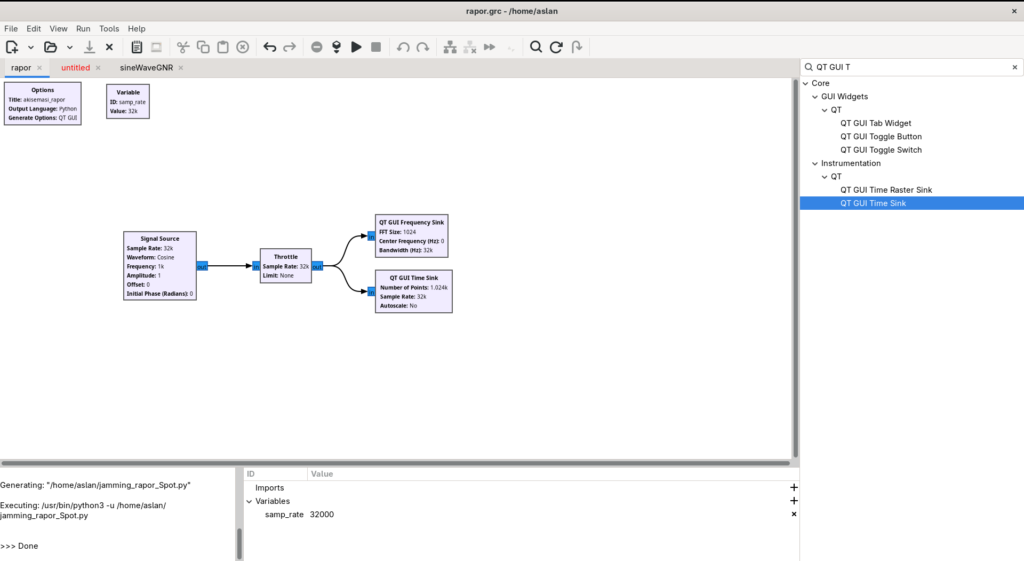
To generate the victim signal, a new flowgraph is created in GNU Radio. The following blocks are then searched and added:
- Signal Source : This block represents the “Victim Signal” (e.g., a radio, remote control, or telemetry data) that we are trying to protect. We define the signal’s frequency (Hertz) and amplitude here.
- Throttle : The flow controller. GNU Radio attempts to generate data as fast as the computer’s CPU allows. The Throttle block restricts the data flow to a real-time sample rate, ensuring the simulation runs stably without overloading the processor.
- QT GUI Frequency Sink : Provides a visual representation of the signal in the Frequency Domain, functioning like a Spectrum Analyzer. The horizontal axis represents frequency, while the vertical axis represents signal power (dB). In our test, the clean signal appears as a sharp “Peak,” whereas the jamming attack manifests as a rising wave of noise from the baseline.
- QT GUI Time Sink : Provides a visual representation of the signal in the Time Domain, functioning like an Oscilloscope. It plots how the waveform changes over time. When the jamming attack commences, this block visually proves how the clean sine waves distort and devolve into chaos
We connect the elements as shown in the visual diagram. The GNU Radio workspace should look like this:
Upon clicking the “Execute” (Play) button, the graphs mentioned in the flowgraph will appear on the screen :
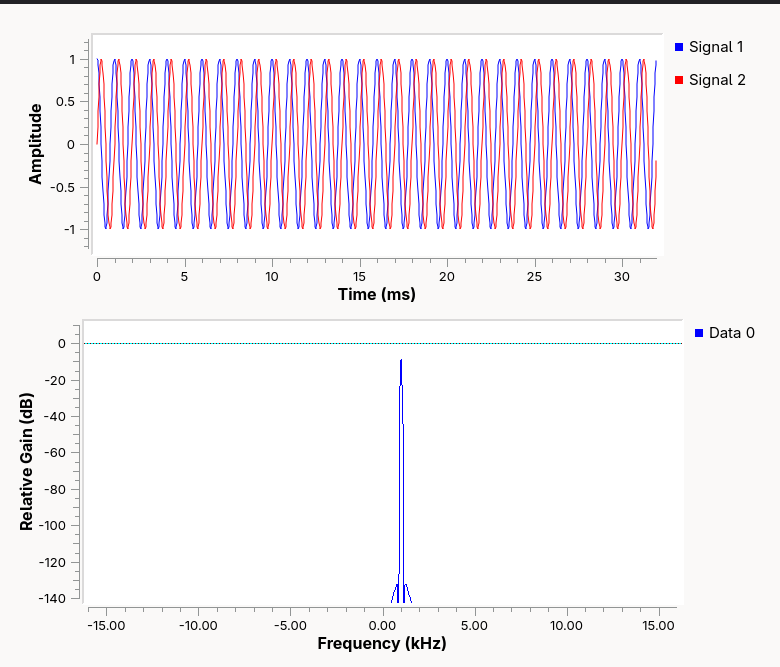
At this stage, we have successfully acquired our Victim Signal. In the next phase, we will introduce the Jammer. To achieve this, we must add a ‘Noise Source’ block to our GNU Radio flowgraph and combine the Signal Source and Noise Source using an ‘Add’ block. The output of this combined ‘Add’ block is then routed to the ‘Throttle’ block.
This architecture yields the following equation: Clean Signal + Noise = Corrupted Signal:
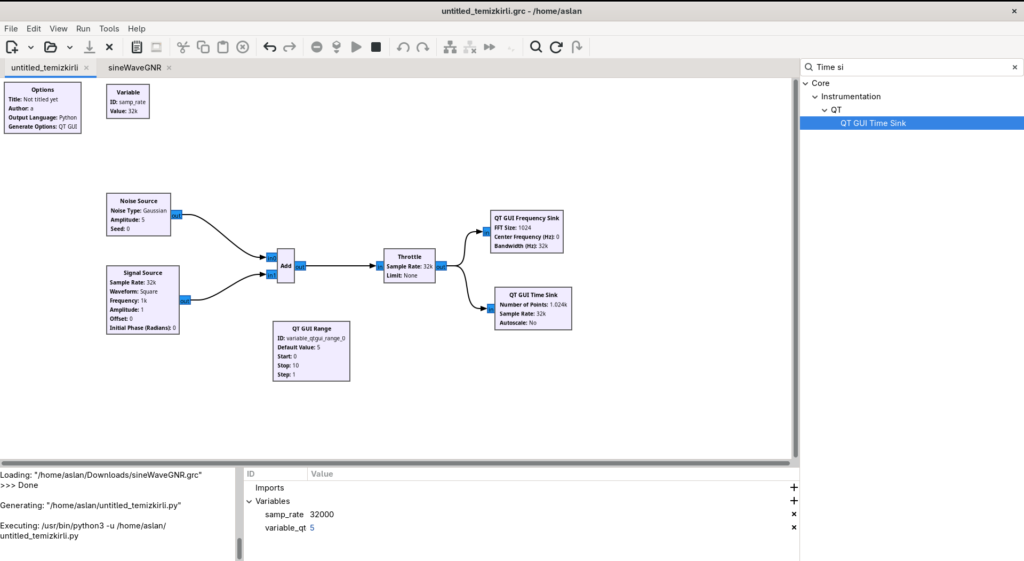
Here, we assign the ID of a ‘QT GUI Range’ block as the Amplitude value of the Noise Source block. This allows us to visually observe and dynamically manipulate the power of the noise in real-time :
When we execute this setup, we encounter the following graphs:
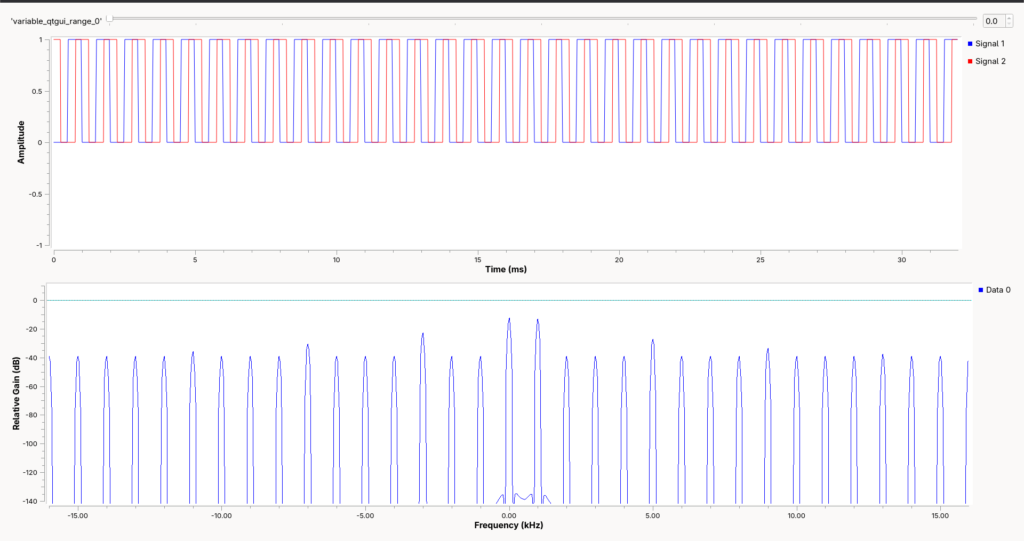
The two peaks near the 0.00 mark on the dB/Frequency graph represent the power of our Victim Signal. We begin to adjust the variable_qtgui_range_0 value, which we previously assigned as the amplitude for the Noise Source. As we increase this value, we observe distinct changes in the dB/Frequency graph. The moment the peak points disappear is the exact moment the noise entirely suppresses the signal.
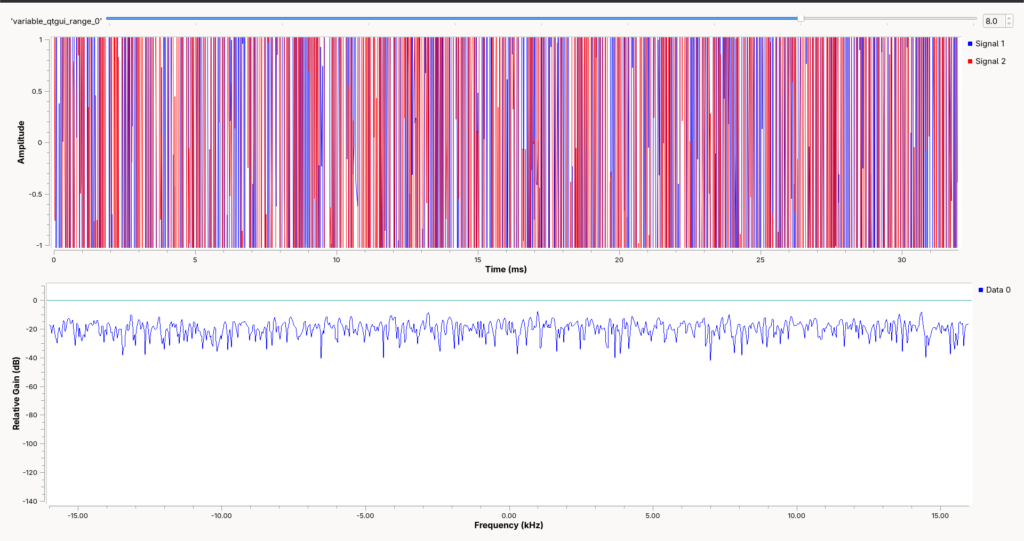
We observe that when we set the variable_qtgui_range_0 value to 8.0, the Victim Signal is completely swallowed. The Jammer is operating with full efficacy.
We must calculate this 8.0 value in terms of decibels using the formula: 20log(SNR) = SNRDB.
When calculated, we obtain a value of approximately -18 decibels. This implies that we can effectively neutralize this victim signal with a -18 dB Jamming attack.
The most effective defense method against these types of wideband Barrage attacks is the Frequency Hopping technique, which we will examine in the next phase. The system can abandon the heavily jammed frequency and seamlessly transition to a clean band.
2- Defence Against Jammer With Using FHSS
Frequency Hopping Spread Spectrum (FHSS) is a method of transmitting radio signals by rapidly switching the carrier among many different frequency channels. This switching occurs based on a pseudo-random sequence known beforehand by both the transmitter and the receiver.
To simulate this, we are going to follow that road :
In the flowgraph established in our previous experiment (Barrage Jamming Simulation), we replace the Noise Source with a second Signal Source. We set the frequency of this second Signal Source to match our Victim Signal. Furthermore, we introduce a second QT GUI Range block for better observation and control.
To avoid confusionlet’s set the ID of one QT GUI Range to kurban_frekansi (Victim Frequency) and the other to jammer_gucu (Jammer Power). Subsequently, we assign the frequency value of the Victim Signal Source to kurban_frekansi, and the amplitude value of the second Signal Source ( which represents the attacker we will be fleeing from ) to jammer_gucu.
The flowgraph now should look like this:
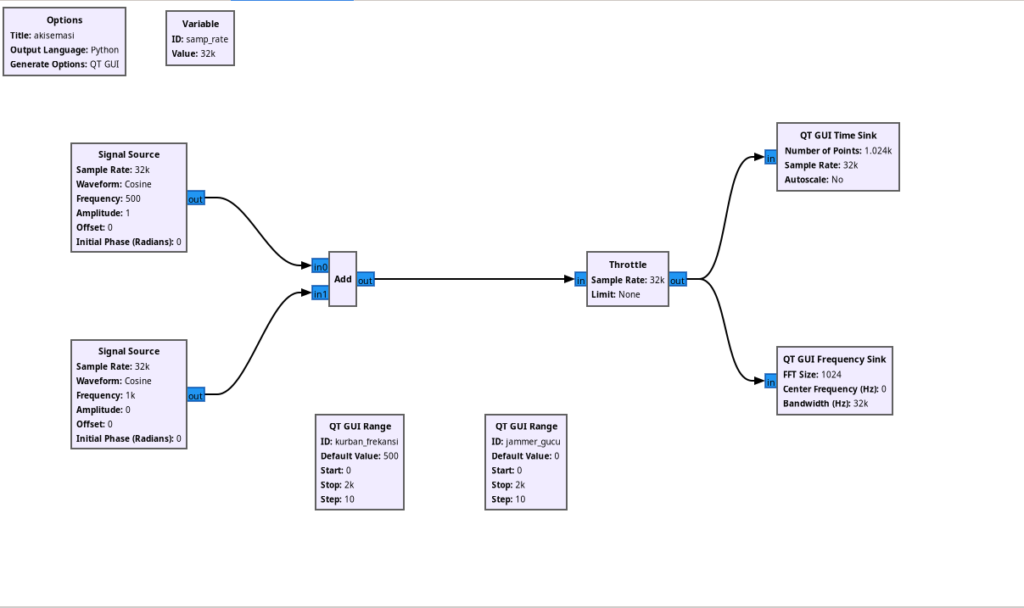
Executing this schema yields the following graphs:
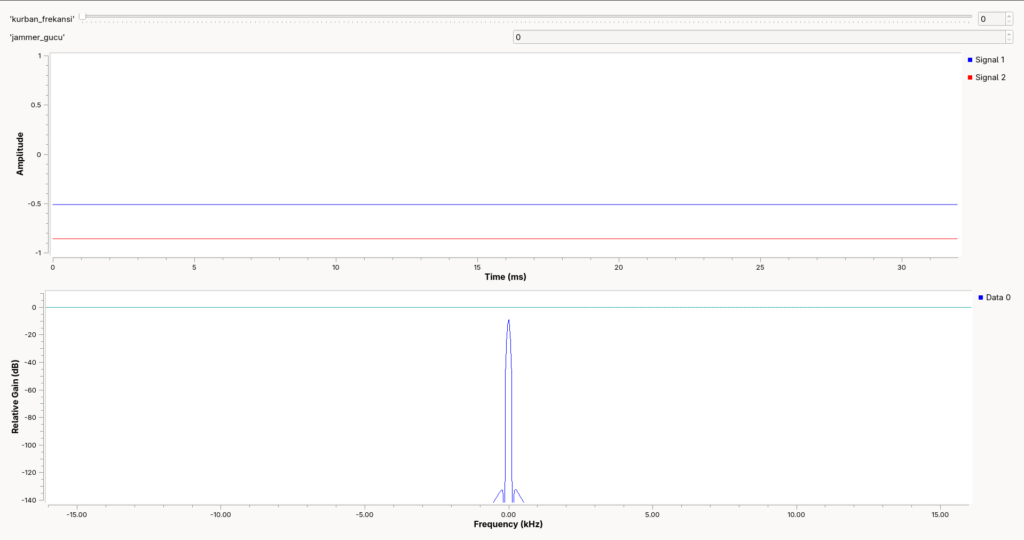
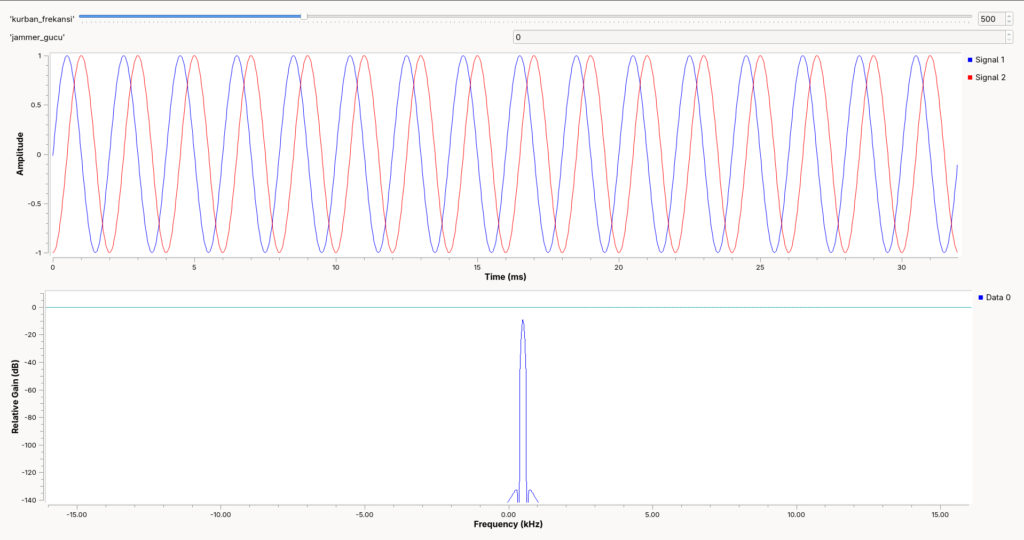
The victim signal begins transmitting while the jammer is inactive. The graphs appear as shown in the visual. Communication proceeds normally.
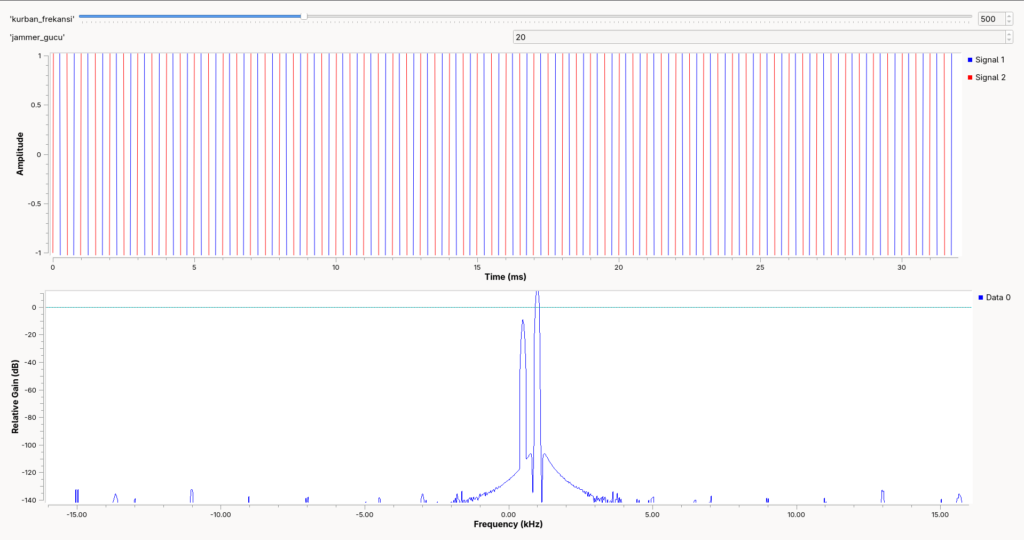
At this point , we activate our jammer ( jammer_gucu = 20) . We observe two distinct peaks on the dB/Frequency graph. We will perform our frequency hopping between these peaks. As we increase the frequency of the victim, the first peak begins to approach the second peak:
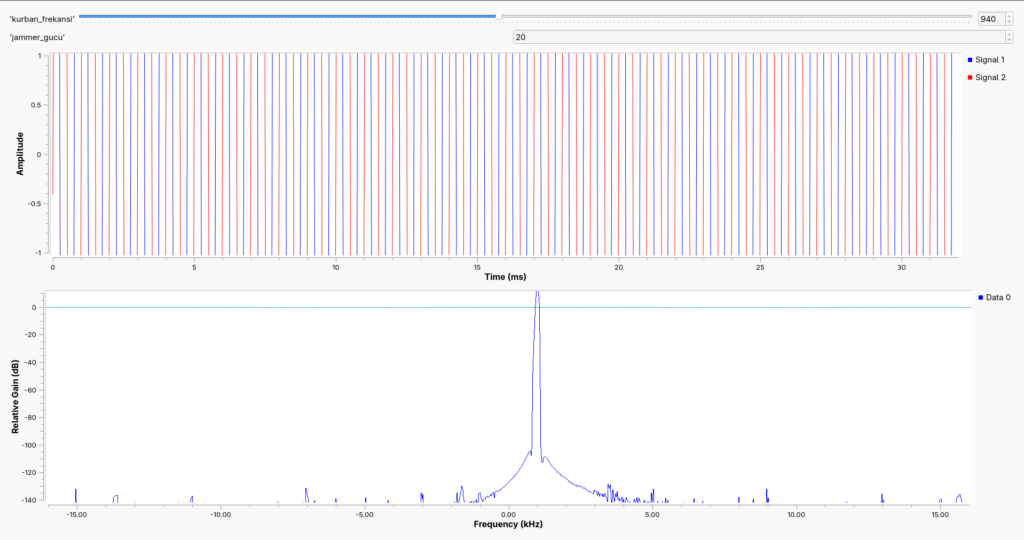
The approaching peaks overlap and collide around the 900 Hz mark. At this precise point, the jammer is functioning as intended, and communication is successfully blocked :
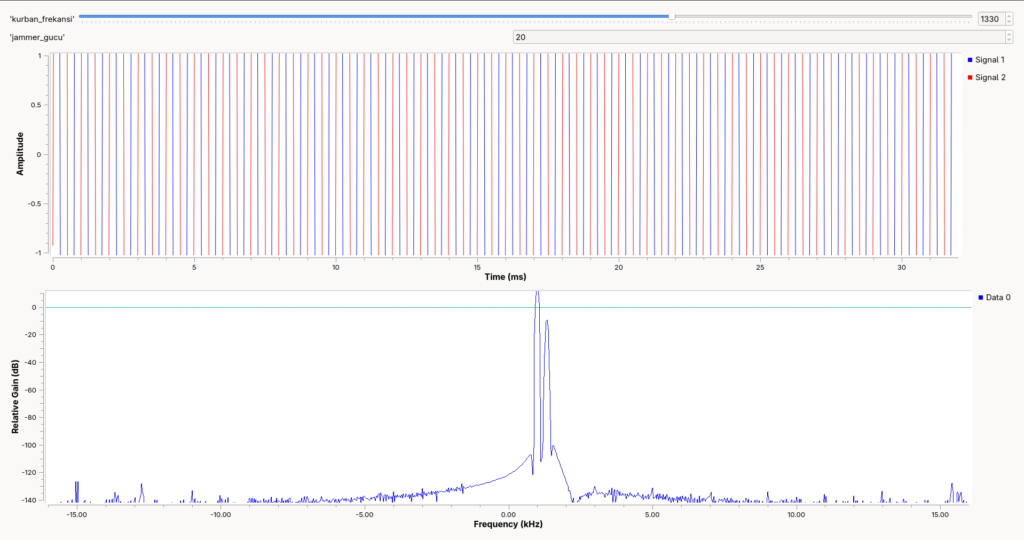
If we increase the Victims Frequency ( kurban_frekansi ) more , we will see that the peaks are seperated. Communication turns back to normal.This operation is done in seconds and a very effective method against Jammer attacks.
In this article, we discussed the concept of jamming, the different types of jammers, and how we can detect and prevent a jamming attack.
REFERENCES
- Atay Mühendislik. “What is a Jammer?”. Atay Mühendislik Technical Blog.
- Bilgi Elması. (2025, April 30). “What is a Jammer? How Does It Work? Where is It Used?” [Video]. YouTube.
- GNU Radio. “Tutorials” and “Your First Flowgraph”. GNU Radio Wiki Official Documentation.
- Phantom Technologies. “Different Types of Jamming”. Phantom Technologies Security Publications.
- Wikipedia. “Radar jamming and deception”. Wikipedia Free Encyclopedia.
About the author
Eyüp Efe Aslan
Signal Master
Subscribe to the newsletter
New cybersecurity articles, research and hardware-lab notes — straight to your inbox.
Related articles
MouseJack Attacks and RF Signal Analysis in nRF24L01+ Chips
Rolling Code (KeeLoq) Cryptography and RollJam Attack Architecture in Wireless Access Systems