
CVE-2026-31431 Technical Analysis: The “Copy Fail” Local Privilege Escalation Vulnerability in the Linux Kernel
1. Introduction – Executive Summary In the cybersecurity world, local privilege escalation (LPE) vulnerabilities are usually carried out through file permissions, misconfigured services, or complex memory overflows. CVE-2026-31431 — disclosed publicly in late April 2026 and codenamed “Copy Fail” — breaks that pattern entirely. It abuses the Linux kernel’s zero-copy mechanisms and cryptographic pipelines to […]
 İsmail Özdoğan
1. Introduction – Executive Summary
In the cybersecurity world, local privilege escalation (LPE) vulnerabilities are usually carried out through file permissions, misconfigured services, or complex memory overflows. CVE-2026-31431 — disclosed publicly in late April 2026 and codenamed “Copy Fail” — breaks that pattern entirely. It abuses the Linux kernel’s zero-copy mechanisms and cryptographic pipelines to manipulate data directly in RAM without ever altering the integrity of the file on disk.
This article examines the anatomy of Copy Fail, the logic flaws at the kernel level, the stages of exploitation in the memory layer, and why this attack constitutes a complete blind spot for traditional EDR/FIM solutions.
All analysis was performed exclusively in an isolated laboratory environment, on authorized systems, for educational and research purposes.
| Field | Value |
|---|---|
| CVE ID | CVE-2026-31431 |
| Affected Product | Linux Kernel |
| Affected Versions | All unpatched kernel branches released after the 2017 optimization (v4.14 and later) |
| Vulnerability Type | Local Privilege Escalation (LPE) |
| CWE | CWE-20: Improper Input Validation |
| CVSS Score | 7.8 / High — CVSS:3.1/AV:L/AC:L/PR:L/UI:N/S:U/C:H/I:H/A:H |
| Impact | Integrity and privilege transfer (root access via RAM manipulation without leaving traces; container breakout) |
| Patch Status | Patched (vendor kernel fixes and temporary mitigations available) |
2. Legal Notice
Legal Notice: This article was prepared solely for cybersecurity awareness, defense, vulnerability management, and educational purposes. The technical information discussed here must only be tested in authorized and isolated laboratory environments. Vulnerability scanning, exploitation attempts, unauthorized access, or any action that may cause service disruption on systems you do not own or have permission to test may result in civil and criminal liability.
Within the Republic of Türkiye, unauthorized access, interference, data destruction, data modification, or denial of service against information systems may be prosecuted under Turkish Criminal Code No. 5237 and related legislation. This work does not target any system and does not encourage misuse.
Implementation Note: All testing in this section was performed in an air-gapped, isolated, and controlled lab environment. It must not be reproduced on production systems.
3. Terminology
| Term | Description |
|---|---|
| CVE | Common Vulnerabilities and Exposures – the standard identification system for security vulnerabilities. |
| CVSS | Common Vulnerability Scoring System – the system used to score the technical severity of vulnerabilities. |
| CWE | Common Weakness Enumeration – the reference taxonomy classifying software and hardware weaknesses. |
| LPE | Local Privilege Escalation. |
| PoC | Proof of Concept – a controlled demonstration that a vulnerability exists. |
| Page Cache | The caching architecture in main memory (RAM) used to accelerate access to files on disk. |
| AF_ALG | The socket interface that lets user-space applications access kernel-level cryptographic algorithms. |
| splice() | A zero-copy system call that transfers data directly between two file descriptors inside the kernel, without copying it to user space. |
| AEAD | Authenticated Encryption with Associated Data – an encryption construction providing both confidentiality and integrity. |
| EDR / FIM | Endpoint Detection and Response / File Integrity Monitoring – threat detection and file integrity monitoring systems. |
4. Vulnerability Identification
| Field | Value |
|---|---|
| CVE ID | CVE-2026-31431 |
| Product / Component | Linux Kernel – Crypto subsystem / algif_aead |
| Vendor | Linux Foundation / Linux Kernel Maintainers |
| Affected Versions | All unpatched kernel branches following the 2017 optimization commit (72548b093ee3) |
| Fixed Version | Upstream stable releases carrying revert commit a664bf3d603d |
| Vulnerability Type | Local Privilege Escalation (LPE) & Container Escape |
| CWE | CWE-20: Improper Input Validation |
| CVSS Score | 7.8 / High (CVSS:3.1/AV:L/AC:L/PR:L/UI:N/S:U/C:H/I:H/A:H) |
| Attack Vector | Local |
| Privileges Required | Low (any authenticated shell user) |
| User Interaction | None (linear logical flow trigger) |
| Impact | Confidentiality (Full), Integrity (Full), Availability (Full) |
| Sources | NVD, MITRE, Ubuntu Security, Microsoft Security Blog, SUSE Bugzilla, Palo Alto Unit 42 |
5. Affected Systems and Versions
The vulnerability stems from a performance optimization introduced into the Linux kernel architecture in 2017. The following systems are directly at risk:
- Linux Kernel: All mainline branches from the integration of commit 72548b093ee3 in 2017 through the May 2026 patches (v4.14 up to current v6.x releases).
- Distributions: Unpatched Red Hat Enterprise Linux (RHEL), SUSE Linux Enterprise, Ubuntu (releases prior to 26.04 Resolute), AlmaLinux, Rocky Linux, and Amazon Linux 2 / 2023.
- Cloud and Container Infrastructure: Kubernetes environments, Docker containers, and CI/CD pipelines that share a kernel are fully exposed to local exploitation.
6. Background
Architectural Background: The Page Cache and the File Integrity Paradox
Performance optimization is one of the most critical concerns in modern operating systems. When a user executes a frequently used binary (for example /usr/bin/su), the kernel does not read it from the slow disk layer every time. Instead, it writes a copy of the file into the Page Cache in RAM. In a normal scenario, if data in the Page Cache is modified, the kernel marks the page as dirty and periodically writes it back to disk. The Copy Fail vulnerability, however, prevents the kernel from flushing this write to disk due to an error condition — leaving the modification resident permanently in RAM only.
Why is this critical? File Integrity Monitoring (FIM) tools such as AIDE, Tripwire, or Osquery verify the cryptographic hashes of physical files on disk. When the in-memory reflection (the Page Cache) is poisoned, the file on disk continues to look perfectly clean while the code actually executing from memory becomes malicious. This blinds traditional security auditing mechanisms.
The AF_ALG and splice() Pairing
The Copy Fail exploit relies on a dangerous combination of two powerful Linux kernel subsystems:
1. The AF_ALG socket interface. The Linux kernel exposes this socket family so that user-space applications can reach hardware-accelerated cryptographic algorithms at kernel level without requiring an additional library. By design, this interface is treated as trusted.
2. The splice() system call (the zero-copy tunnel). splice() transfers data directly between two file descriptors inside the kernel, without the overhead of pulling the data into user space and copying it back. This zero-copy mechanism is revolutionary for performance — but it also provides exactly the tunnel the Copy Fail attack requires.
The flaw. A performance optimization added to the kernel in 2017 began allowing the source and destination addresses of a cryptographic operation to be identical (req->src = req->dst, i.e. in-place processing). Using splice(), an attacker can map the Page Cache page of a SUID file — opened with read-only permissions — as the direct destination address of an encryption/decryption operation executed over AF_ALG.
7. Technical Root Cause Analysis
The 4-Byte “Scratch Write” Primitive
How can a low-privileged user, who normally has no write access, inject controlled data into a read-only memory page? This is where a linear logic flaw in the authencesn AEAD template — used for IPsec ESN (Extended Sequence Number) support — comes into play.
The process is manipulated in the following steps:
• Building the tunnel. A chosen SUID file (for example /usr/bin/su) is opened with O_RDONLY and attached to an AF_ALG socket structure via a splice() call.
• Preparing the data. The attacker crafts a specially structured data packet for memory manipulation. Into the Extended Sequence Number (ESN) field of this packet, they place the 4 bytes of data (a fragment of shellcode) they want written to their target offset in the Page Cache.
• The critical logic flaw (the scratch write). Immediately before verifying the integrity and cryptographic correctness of the data (HMAC), the authencesn algorithm writes this 4-byte sequence number to the destination address — which, in this scenario, is the shared Page Cache region of our SUID file — purely for operation tracking. This step is known as the scratch write.
• The missing rollback. Because the packet is deliberately sent with an incorrect HMAC integrity key, the kernel check fails and the algif_aead module returns an error code. The core problem is this: kernel developers never designed a rollback mechanism to undo the 4 bytes of temporary data already written when decryption fails. As a result, the 4-byte leak persists in RAM.
• The 40-iteration technique. Only 4 bytes can be written per iteration, while a minimal privilege-escalation shellcode is roughly 160 bytes long. A red team operator advances the memory offset in the Page Cache by 4 bytes on each iteration and repeats the operation exactly 40 times. At the end of the process, the entry point of the in-memory /usr/bin/su has been entirely replaced with the attacker’s shellcode.
8. Attack Surface and Prerequisites
Several prerequisites must be satisfied together before this vulnerability poses a practical risk on a real target system:
- Version compatibility. The target must run one of the unpatched Linux kernel versions (2017–2026) that contains the relevant optimization code.
- Local footprint. The attacker must already hold a shell on the system — obtained through remote code execution (RCE) or direct SSH/user interface access — with at least the lowest-privileged account (
nobody,www-data, a standard user, etc.). The vulnerability cannot be triggered remotely on its own. - AF_ALG access. The system configuration or container seccomp profile must permit creation of AF_ALG sockets (enabled by default in most Linux installations).
- A readable SUID binary. The SUID binary the attacker intends to manipulate in memory must be at least readable.
9. Impact Analysis
The threat level posed by Copy Fail is critical and can produce cascading effects in enterprise environments:
• Full confidentiality and integrity breach. Attackers can obtain root privileges by planting a fully RAM-resident backdoor without making any persistent change on disk. This thoroughly misleads forensic processes and incident response teams.
• Container escape and multi-tenancy risk. In modern microservice architectures, containers share the host machine’s kernel. Because the Page Cache is shared host-wide, a low-privileged attacker running inside an isolated Docker container can poison a file on the host and pivot directly onto the host machine (container breakout).
• CI/CD and pipeline security. In shared infrastructure and automated build/test pipelines, a malicious script injected into a project can use this technique to seize control of the entire CI/CD server.
• Deterministic nature. Unlike Dirty Pipe or Dirty COW, this vulnerability does not depend on unstable race conditions; it is 100% deterministic. It therefore works reliably on the first attempt with no risk of crashing the system.
10. Practical Lab Walkthrough: Step-by-Step Exploitation
This section complements the theoretical analysis in the preceding chapters and documents, step by step, how CVE-2026-31431 (Copy Fail) was exploited end to end in an isolated, authorized TryHackMe lab. The test was carried out as a low-privileged user on a temporary virtual machine provisioned by TryHackMe strictly for educational purposes. Unlike the “safe verification” approach described in Section 11, what follows is a full end-to-end validation — justified because the target is not a production system but an isolated training lab that exists for this purpose. The target IP address, credentials, and lab flag value have been deliberately withheld from this document in accordance with platform rules.
10.1 Environment Reconnaissance and Target Validation
The lab machine was accessed as a low-privileged user via the SSH credentials supplied by the room. As with any exploitation attempt, the first step is validating the environment: the user identity, kernel version, and distribution information were checked.
id
uname -a
cat /etc/os-release

The result confirmed a low-privileged user identity and a target running Ubuntu 24.04 LTS with a 6.8.x kernel — consistent with the affected version range described in Section 5.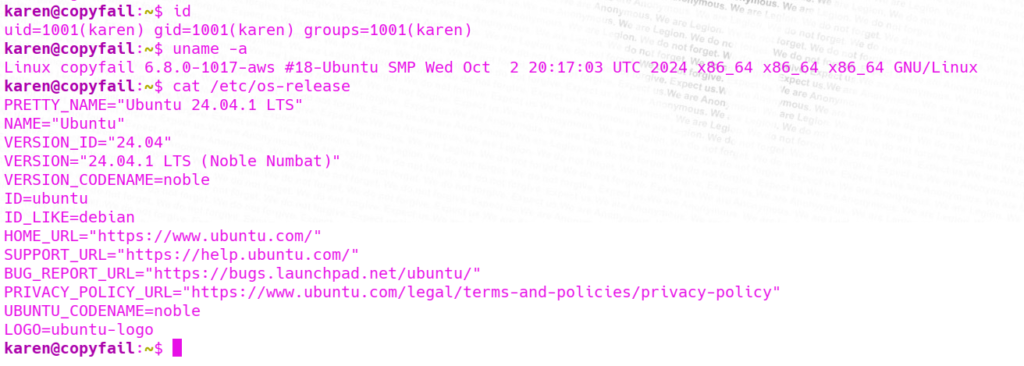
10.2 Obtaining a Verified PoC
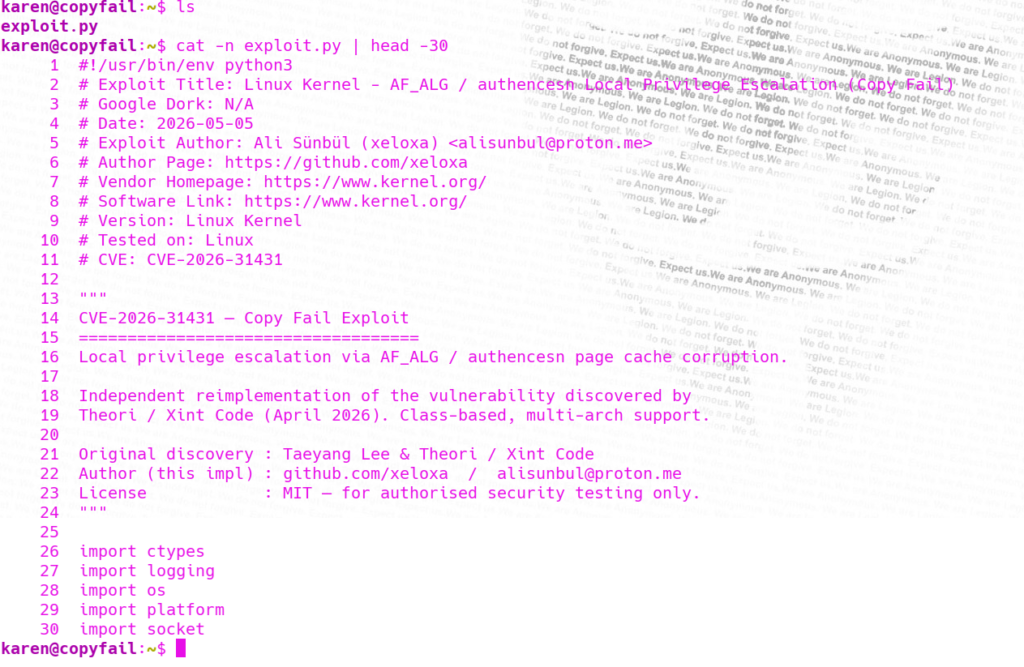
Alongside the original Xint Code / Theori disclosure listed in the references, an independent community-produced Python reimplementation (MIT licensed, published with an “authorized security testing only” notice) was used as reference. The exploit script was obtained and reviewed for correctness before execution.
10.3 Transferring the PoC to the Target
The reviewed script was uploaded to the user’s home directory on the target system over SCP.
scp exploit.py <user>@<target-ip>:/home/karen/exploit.py

10.4 Compatibility Check (–check)
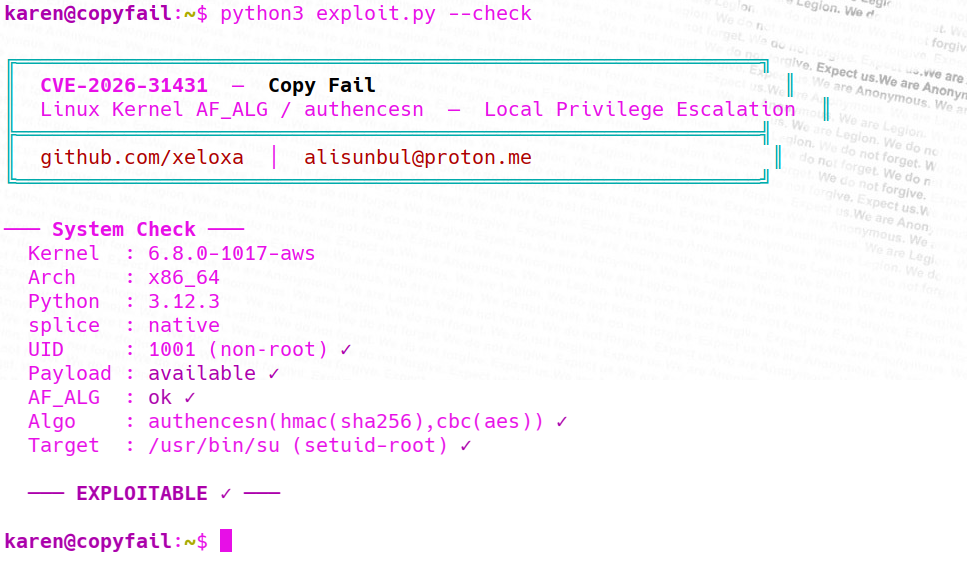
Running the script with the --check parameter tests whether the target is vulnerable, purely for detection purposes and without performing any write operation:
python3 exploit.py --checkThe output verified the kernel version, the architecture (x86_64), that the AF_ALG socket family was reachable, that the authencesn(hmac(sha256),cbc(aes)) algorithm was registered, and that /usr/bin/su was available as a SUID-root target — producing an “EXPLOITABLE” verdict.
10.5 Triggering the Exploit
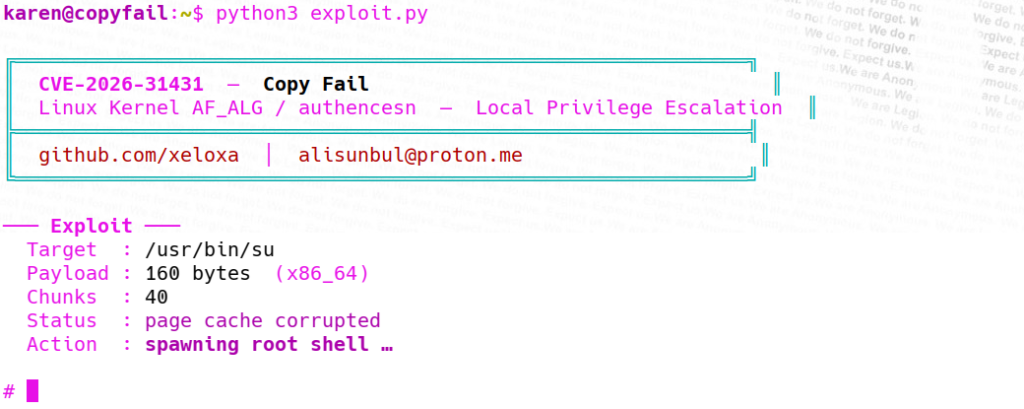
Following the check step, the exploit was executed directly. Using the 4-byte scratch write primitive described in Section 7, the tool overwrote the page cache reflection of the target SUID binary with a small architecture-specific payload in 4-byte iterations, then executed the corrupted page cache content directly via execve().
python3 exploit.pyImmediately after the “page cache corrupted” and “spawning root shell…” lines appeared in the tool’s output, the shell prompt turned into a root prompt — with no crash, no retry, and no perceptible delay. This confirms in practice the “deterministic, race-condition-free” nature emphasized in Section 9.
10.6 Verifying Root Access
The resulting shell was confirmed to be running with root privileges by displaying the user identity and demonstrating that a normally read-only system file could now be read:
id
whoami
Result: uid=0(root) — full privilege escalation achieved purely through the page cache in RAM, without any persistent change to the on-disk filesystem. This is concrete proof of the “leaves no trace on disk” property described in Section 9.

10.7 Capturing the Lab Flag
With root privileges obtained, the flag file marking completion of the lab was read and the exercise concluded. The actual flag value is not shared in this document, in line with the rules of most training platforms.

10.8 Summary of Findings
| Field | Value |
|---|---|
| Target Operating System | Ubuntu 24.04.1 LTS |
| Kernel | 6.8.0-1017-aws (x86_64) |
| Technique Used | AF_ALG / authencesn 4-byte scratch write primitive (iterative writes) |
| Target SUID Binary | /usr/bin/su |
| Retries Required | None — deterministic result on the first attempt |
| Outcome | uid=0(root) obtained; lab flag successfully read |
This practical run demonstrates that the theoretical mechanism described in Sections 7 and 9 holds exactly on a real system: escalation from a low-privileged user to root was achieved with a single script execution, without any filesystem modification and without relying on a race condition.
11. Safe Verification Approach
In line with Hardwarelab laboratory principles, fully functional exploit payloads and automation details that could enable misuse against real systems are not published. Instead, the following steps are used to safely determine whether a system is exposed:
1. Version check. Confirm whether the kernel version falls within the affected range using uname -r.
2. Module status. Check whether the algif_aead module is loaded and active on the system.
3. Harmless PoC approach. During attack simulation, instead of a damaging root shell payload, write only a 4-byte marker (AAAA) into a harmless region of the Page Cache (for example the cache of a purpose-created test text file) and track success through the logs. This avoids manipulating live system components.
12. Detection and Log Analysis
The fact that the attack leaves no trace on disk makes detection difficult but not impossible. Defensive teams (blue team / threat hunting) should focus on behavioral telemetry:
• Socket volume. A single process (PID) opening and closing more than 40 AF_ALG sockets back to back within a very short window (milliseconds) is anomalous.
• splice() correlation. A SUID binary (su, sudo, pkexec, etc.) attaching to a cryptographic socket interface via a splice() system call outside its normal workflow is a direct alerting condition.
• Process sequence. The relevant SUID binary spawning a child process via execve() immediately after the exploitation loop.
13. Mitigation and Remediation
Permanent Fix (Patch Management)
The most reliable and permanent solution is to rapidly apply the current kernel patches officially released by your Linux distribution vendor (Ubuntu, Red Hat, SUSE, etc.). The patch reverts the flawed 2017 optimization loop and enforces strict separation of source and destination memory mappings.
Remember to reboot into the new kernel after updating.
Temporary Measures (System Hardening)
For critical workloads or production servers where the vendor patch cannot be applied immediately, the following steps reduce the exposed surface:
1. Blacklist the module. If your system has no need for IPsec ESN or kernel-level hardware-accelerated cryptography, you can prevent the vulnerable submodule from loading entirely:
echo "blacklist algif_aead" | sudo tee -a /etc/modprobe.d/blacklist.conf
sudo rmmod algif_aead
2. Block at the GRUB level (alternative). On some ARM64 / AWS architectures where the module is built into the kernel, rmmod will fail. In that case, block the relevant init call through GRUB:
sudo grubby --update-kernel ALL --args "initcall_blacklist=algif_aead_init"
14. Conclusion
CVE-2026-31431, “Copy Fail,” once again demonstrates how fragile the thin line between performance and security can be in modern operating systems. For a red team operator, this vulnerability is a textbook example of a silent, deterministic vector that attacks the system’s most trusted component — the kernel crypto API. On the defensive side, it makes clear that the era of static file security (hash-based auditing) is closing, and that the future lies in runtime security, eBPF-based deep kernel telemetry, and proactive hardening.
15. TL;DR
- What it is: CVE-2026-31431 is a critical Local Privilege Escalation (LPE) vulnerability in the Linux kernel (crypto subsystem /
algif_aead). - Affected versions: All kernels unpatched since the 2017 optimization (v4.14 – v6.x).
- Severity: CVSS 7.8 (High) — its operational impact is considerably higher due to the stable, deterministic nature of exploitation.
- Attack mechanism: The Page Cache (RAM) reflection of a SUID file is attached to the
algif_aeadmodule through a zero-copy tunnel, and the 4-byte leak occurring before the integrity check fails is abused to poison RAM. - Permanent fix: Apply official vendor kernel patches without delay.
- Temporary measures: Blacklist the
algif_aeadkernel module and deploy in-depth runtime monitoring (Falco/eBPF).
16. References
- TryHackMe – Copy Fail room: https://tryhackme.com/room/cve202631341
- Copy Fail disclosure site: https://copy.fail/#exploit
- NVD – CVE-2026-31431: https://nvd.nist.gov/vuln/detail/CVE-2026-31431
- Ubuntu Security – Copy Fail vulnerability fixes: https://ubuntu.com/blog/copy-fail-vulnerability-fixes-available
- MITRE – CVE-2026-31431: https://cve.mitre.org/cgi-bin/cvename.cgi?name=CVE-2026-31431
- Bugcrowd – What we know about Copy Fail: https://www.bugcrowd.com/blog/what-we-know-about-copy-fail-cve-2026-31431/
About the author
İsmail Özdoğan
Author
Subscribe to the newsletter
New cybersecurity articles, research and hardware-lab notes — straight to your inbox.
Related articles
CVE-2026-25769 Analysis: Remote Code Execution in Wazuh Cluster via Insecure Deserialization

WordPress REST API Batch Endpoint Exploit Chain (wp2shell): From Route Confusion to Remote Code Execution