CVE-2026-37603 & CVE-2026-37604: Admin Brute-Force Protection Bypass Chain in pH7Builder
CVE: CVE-2026-37603 (CWE-307) · CVE-2026-37604 (CWE-290)CVSS v3.1: 6.5 (Medium) for each vulnerabilityAffected versions: ≤ 18.2.0 (both) · ≤ 19.2.0 (CVE-2026-37603 only)Fixed in: 18.3.0 for CVE-2026-37604. CVE-2026-37603 unfixed at time of writing An attacker who can reach the administration panel of an affected pH7Builder installation over the network can guess administrator passwords without any of the […]
 Haluk Baran Akbulut
CVE: CVE-2026-37603 (CWE-307) · CVE-2026-37604 (CWE-290)
CVSS v3.1: 6.5 (Medium) for each vulnerability
Affected versions: ≤ 18.2.0 (both) · ≤ 19.2.0 (CVE-2026-37603 only)
Fixed in: 18.3.0 for CVE-2026-37604. CVE-2026-37603 unfixed at time of writing
An attacker who can reach the administration panel of an affected pH7Builder installation over the network can guess administrator passwords without any of the limits the application is meant to impose. No attacker account or prior authentication is required, and no action by a legitimate user is needed. The product ships three measures to make password guessing expensive: a challenge that appears after repeated failures, a counter of failed attempts, and a temporary block on the source of those attempts. All three can be made ineffective, leaving the attack bounded by network and server capacity rather than by any authentication control. In the laboratory run the correct password was recovered without either intended control being triggered.
Both flaws are rate-limiting failures of the same shape: the state that decides whether to challenge or block a request is stored under a key the requester chooses. CVE-2026-37603 keys the challenge on the PHP session, which any client can obtain on demand. CVE-2026-37604 keys the block on a client IP address read from request headers. The findings were reproduced in an isolated lab against 18.1.0 and then traced through the published source of every tagged release, from 1.2.7 (December 2015) to 19.2.0 (see Section 9 and Section 10 for the root cause, Section 11 for the lab work, and Section 11.3 for what upstream has and has not fixed).
Contents
- 1. Executive Summary
- 2. Legal Notice and Scope
- 3. Disclosure Timeline and Vendor Coordination
- 4. Terminology
- 5. Vulnerability Identification
- 6. Background
- 7. Attack Surface and Preconditions
- 8. Attack Flow
- 9. Link 1 — Session-Bound Challenge State (CVE-2026-37603)
- 9.1 Principle Violated
- 9.2 The Vulnerable Code
- 9.3 Step-by-Step Trace with Concrete Values
- 9.4 Analogy
- 9.5 Architectural Root Cause
- 10. Link 2 — Attacker-Controlled Client-IP Resolution (CVE-2026-37604)
- 10.1 Principle Violated
- 10.2 The Vulnerable Code
- 10.3 Step-by-Step Trace with Concrete Values
- 10.4 Analogy
- 10.5 Architectural Root Cause
- 11. Hands-On Demonstration
- 11.1 Lab Environment
- 11.2 Step-by-Step Verification
- 11.3 Patch Status and Regression Testing
- 12. Impact Analysis
- 13. Detection and Log Analysis
- 14. Remediation and Secure Coding Lessons
- 14.1 Secure Coding Lessons
- 15. Real-World Context
- 16. Conclusion
- 17. References
- Appendix A — Glossary
1. Executive Summary
This is a chain of two independent flaws rather than a single defect. pH7Builder layers three defences over the administration login: a CAPTCHA challenge that appears after a failure, a counter of failed attempts, and a timed lockout of the offending source. All three collapse into two decisions, and each of those decisions is made from data the client supplies. Each credential guess can therefore be presented under a fresh session and, on versions affected by the second flaw, under a fresh rate-limit key as well. The two links are not interchangeable: CVE-2026-37603 on its own removes the CAPTCHA escalation but leaves the per-address attempt counter intact, and it is CVE-2026-37604 that removes that remaining bound.
Fresh session per attempt  ⟶  no challenge, no escalation  ⟶  fresh claimed IP per attempt  ⟶  no lockout  ⟶  password guessing with no application-level limit
(CVE-2026-37603)                (CWE-307)                     (CVE-2026-37604)                 (CWE-290)      (unauthenticated, remote)
| # | Link | Class (CWE) | Role in the chain |
|---|---|---|---|
| 1 | Session-bound challenge state (CVE-2026-37603) | CWE-307 (Improper Restriction of Excessive Authentication Attempts) | The flag that makes the CAPTCHA appear lives in the PHP session, so discarding the session cookie removes the challenge from the form entirely. |
| 2 | Attacker-controlled client-IP resolution (CVE-2026-37604) | CWE-290 (Authentication Bypass by Spoofing) | The attempt counter and lockout are keyed on an IP address read from request headers, so a new header value is a new, empty counter. |
Key insight: neither link is a probabilistic race or a timing artefact. Both are deterministic lookups against a key the attacker obtains at no cost, which is why the outcome is not a weakened throttle but an inapplicable one: on every request, the state the application consults has no record of the attacker to escalate against.
2. Legal Notice and Scope
Legal notice: this article is published solely for security awareness, defence, vulnerability management, and education. The techniques described must only be reproduced in authorised, isolated laboratory environments. Scanning, exploitation attempts, unauthorised access, or any action that may cause service disruption against systems you do not own or have explicit written permission to test may constitute a criminal offence. In Türkiye, unauthorised access to and interference with information systems is addressed under the Turkish Penal Code No. 5237 (Articles 243–245).
Scope and PoC policy: this analysis explains the root cause at source level, with the raw HTTP request and response pairs needed to understand and detect the attack. End-to-end automation tooling is not published. Only its operating logic is summarised (see Section 11.2). All testing was performed on an isolated laboratory network with no internet egress, against an installation of pH7Builder 18.1.0 deliberately left unpatched for the purpose. No third-party system was touched, and the only account attacked was one created by the researcher. Source-level claims about releases other than 18.1.0 were made by reading the public repository at each release tag, not by attacking any live installation.
3. Disclosure Timeline and Vendor Coordination
This section is an addition to the standard structure, included because this article is the disclosure itself rather than a commentary on someone else’s. Individual contact addresses are omitted deliberately.
| Date | Event |
|---|---|
| 2026-03-04 | Both issues identified during security research on pH7Builder 18.1.0. |
| 2026-03-05 | Vendor notified through the project’s published contact address, the maintainer’s public contact address, and a direct message. The repository carried no SECURITY.md or private advisory channel at that time. One was added later, in release 18.5.0. |
| 2026-03-12 | CVE assignment requested from MITRE after seven days without a vendor response. |
| 2026-05-21 | CVE-2026-37603 and CVE-2026-37604 reserved by MITRE. |
| 2026-06-08 | Release 18.3.0 published. It contains a fix for the IP-resolution flaw (CVE-2026-37604). No advisory, no changelog entry referencing the report, and no reply to the researcher. |
| 2026-09-19 | Public disclosure. The 90-day window has long elapsed, the session-reset flaw (CVE-2026-37603) remains unfixed in the current release, and no vendor communication has been received to date. |
Stated as observation rather than inference: a fix for one of the two reported issues shipped roughly three months after notification, and no advisory or changelog entry identified the security relevance of that change. No correspondence was received at any point. The CVE records are reserved but not yet published, so the cve.org links in Section 17 may return an unpopulated record until MITRE publishes them.
4. Terminology
| Term | Definition |
|---|---|
| CVE | Common Vulnerabilities and Exposures — the standard identifier scheme for publicly known flaws |
| CVSS | Common Vulnerability Scoring System — a scheme for scoring technical severity |
| CWE | Common Weakness Enumeration — a taxonomy of software and hardware weakness classes |
| PoC | Proof of Concept — a controlled demonstration that a flaw exists |
| XFF | X-Forwarded-For — an HTTP header conventionally used by proxies to record the originating client address |
| Rate-limit key | The value a rate limiter groups requests under when deciding whether a threshold has been crossed |
5. Vulnerability Identification
| Field | CVE-2026-37603 | CVE-2026-37604 |
|---|---|---|
| Product / component | pH7Builder (pH7 Social Dating CMS) — admin login form, admin123 module | pH7Builder (pH7 Social Dating CMS) — _protected/framework/Ip/Ip.class.php |
| Vendor | pH7Software / Pierre-Henry Soria | pH7Software / Pierre-Henry Soria |
| Affected versions | All versions through 19.2.0 | All versions through 18.2.0 |
| Fixed in | Not fixed at time of writing | 18.3.0, released 2026-06-08 (see Section 11.3) |
| Vulnerability class | Authentication throttling bypass via session reset | Authentication throttling bypass via client-IP header spoofing |
| CWE | CWE-307 — Improper Restriction of Excessive Authentication Attempts | CWE-290 — Authentication Bypass by Spoofing |
| CVSS v3.1 base score | 6.5 — Medium | 6.5 — Medium |
| CVSS vector | CVSS:3.1/AV:N/AC:L/PR:N/UI:N/S:U/C:L/I:L/A:N | CVSS:3.1/AV:N/AC:L/PR:N/UI:N/S:U/C:L/I:L/A:N |
| Attack vector | Network | Network |
| Privileges required | None | None |
| User interaction | None | None |
| MITRE ATT&CK | T1110 — Brute Force | T1110 — Brute Force |
| Reservation / disclosure date | Reserved 2026-05-21 / disclosed 2026-09-19 | Reserved 2026-05-21 / disclosed 2026-09-19 |
| Public exploit available | No public exploit at time of writing | No public exploit at time of writing |
Note on corroboration: at the time of writing both records are reserved with MITRE and not yet published, so no NVD entry exists to corroborate these rows against. Every field above is derived from the researcher’s own testing and from the vendor’s published source. The version ranges were established by checking both code paths at every one of the 141 release tags in the vendor’s repository, the earliest being 1.2.7 dated 2015-12-24; both are present unchanged from that tag onward. Scores are the researcher’s own assessment under CVSS v3.1 and have not been reviewed by a CNA or by NVD.
6. Background
pH7Builder (formerly pH7CMS) is an open-source social networking and dating CMS written in PHP. Its administration panel lives, by default, under the /admin123/ path, and the login form at /admin123/main/login is the component under analysis.
What this component does under normal conditions:
- A
GETrequest to the login URL starts a PHP session, issues aPHS7SESScookie, and renders the login form with a CSRF token bound to that session. - The form is assembled conditionally: an email field, a username field, a password field, and, only if the current session is marked as having already failed a login, a CAPTCHA field.
- A
POSTis validated element by element against the form definition, then the submitted credentials are checked against theadminstable. - On failure, the application records the attempt in a per-IP counter table, marks the session so the next render of the form includes a CAPTCHA, and sleeps briefly before responding.
- If the per-IP counter has reached the configured maximum, the login handler refuses to evaluate credentials at all until a timeout expires.
// Intended shape of the control, as expressed in LoginFormProcess.php
if ($bIsLoginAttempt && !$oSecurityModel->checkLoginAttempt(/* ... */)) {
    \PFBC\Form::setError('form_admin_login', Form::loginAttemptsExceededMsg($iTimeDelay));
    return; // credentials are never evaluated
}
// ... credentials checked; on failure:
$oSecurityModel->addLoginAttempt(DbTableName::ADMIN_ATTEMPT_LOGIN);
$this->enableCaptcha();
The design is sound in outline: escalate to a challenge after one failure, refuse entirely after several. The break is not in the escalation logic but one level below it, in how the application decides which counter and which challenge state a given request belongs to. See Section 9 and Section 10 for the source-level detail.
7. Attack Surface and Preconditions
| Precondition | Required? | Notes |
|---|---|---|
| pH7Builder within the affected range | Yes | Version is shown in the admin footer; the release tag of a deployed tree can be read from _protected/framework/Security/Version.class.php |
| Admin login endpoint reachable | Yes | Default path /admin123/main/login; no authentication needed to reach it |
| Authentication | None | Both flaws are exercised by an entirely unauthenticated client |
| User interaction | None | No administrator action is needed at any point |
isAdminLoginAttempt enabled | Not required | Default: 1 (enabled). The chain works whether the control is on or off; when it is on, Link 2 is what neutralises it |
| Application behind a reverse proxy | No (for ≤ 18.2.0) | Header trust is unconditional in the affected range, so no proxy is needed for Link 2. From 18.3.0 the relevance of a proxy inverts — see Section 11.3 |
| Network position | Network-reachable | Any client with network access to the admin endpoint, whether from the internet or an internal network |
Default configuration assessment: on an affected version, a default installation is vulnerable, and no non-default setting is needed to reach either flaw. The shipped defaults are isAdminLoginAttempt = 1, maxAdminLoginAttempts = 10 and loginAdminAttemptTime = 120 minutes. In other words the product ships with brute-force protection enabled, and the chain defeats it in that configuration. No unusual setting, plugin or deployment topology is required.
Non-destructive exposure check:
# Confirms the admin panel is reachable and issues a session cookie.
# Sends no credentials and creates no failed-login record.
curl -sSI "https://TARGET_HOST/admin123/main/login" | grep -Ei '^(HTTP/|set-cookie)'
A response carrying a Set-Cookie: PHS7SESS=... header confirms the endpoint is exposed and that a fresh session is handed out on request. Whether the installation is affected then depends on the version.
8. Attack Flow
Under normal operation the CAPTCHA state and the lockout counter are meant to accumulate across an attacker’s attempts, so that the tenth request is treated differently from the first. What connects the attacker’s requests in the application’s mind is not the attacker but a session cookie and an IP string, both of which travel in the request itself.
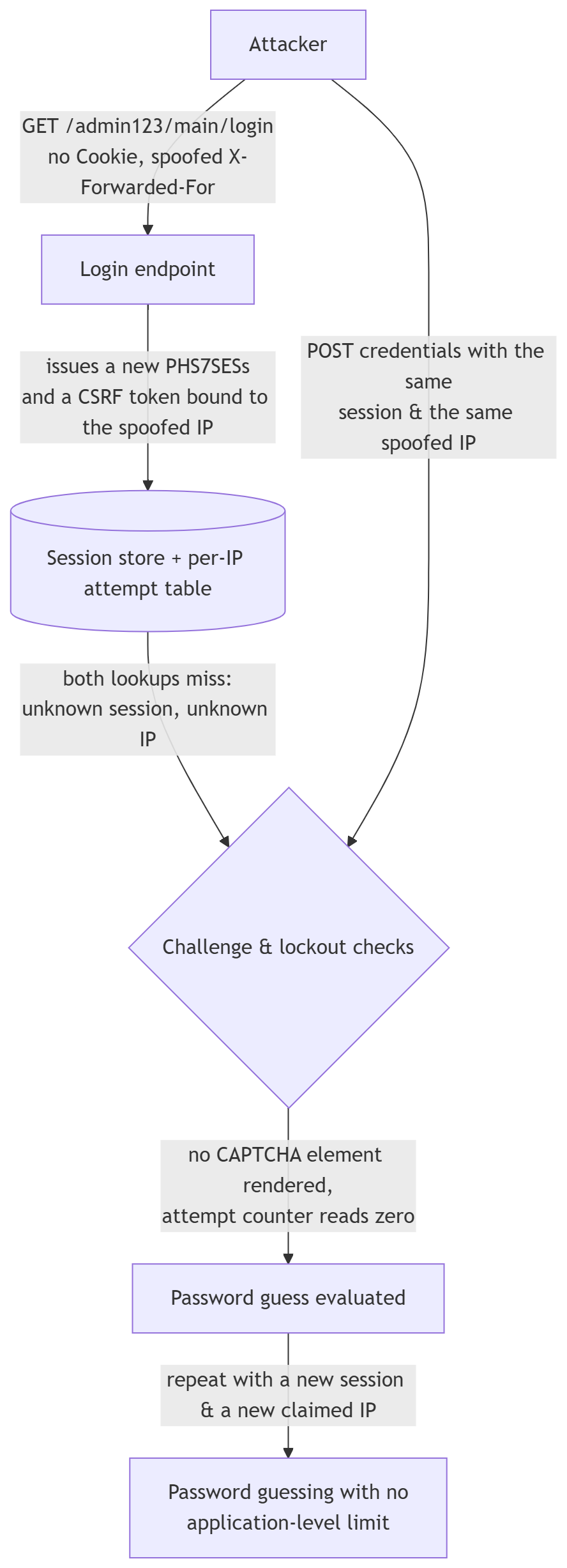
Every guess is the application’s first encounter with a brand-new visitor, so the escalation logic never has a history to escalate against.
9. Link 1 — Session-Bound Challenge State (CVE-2026-37603)
9.1 Principle Violated
A control that escalates after failure must store its state under a key the failing party cannot choose. The key has to be bound to the thing being protected, such as the account, or to something the client cannot create at will. A session cookie is neither: for an unauthenticated visitor a session is free, unlimited, and issued on request.
pH7Builder stores the escalation state in $_SESSION, under the key captcha_admin_enabled, and reads it back when deciding whether to build a CAPTCHA field into the form. Because the session is selected by a cookie the client sends, the client also selects which escalation history applies to its request.
Expected behaviour:
POST attempt #1 (wrong password)  -> "Password is incorrect"
POST attempt #2 (wrong password)  -> CAPTCHA required, credentials not evaluated
Vulnerable behaviour:
GET (no Cookie) -> PHS7SESS=<S1>;  POST with <S1> (wrong password) -> "Password is incorrect"
GET (no Cookie) -> PHS7SESS=<S2>;  POST with <S2> (wrong password) -> "Password is incorrect"
GET (no Cookie) -> PHS7SESS=<S3>;  POST with <S3> (wrong password) -> "Password is incorrect"
Technical nuance: the CAPTCHA is not being submitted and accepted incorrectly. It is never instantiated at all. The form engine validates only the elements present in the form definition, and the CAPTCHA element is added conditionally at render time. For a fresh session there is no CAPTCHA element, therefore no CAPTCHA validator, therefore nothing to bypass. This matters for anyone testing the control: submitting a wrong CAPTCHA value produces a correct-looking rejection, and a tester who stops there will conclude the defence works.
9.2 The Vulnerable Code
// _protected/app/system/modules/admin123/forms/LoginForm.php

// ...
if (static::isCaptchaEligible()) {           // VULNERABILITY HERE:
    $oForm->addElement(new CCaptcha(/* ... */));  // the challenge exists only if the
}                                                 // client's own session says so
// ...

public static function isCaptchaEligible(): bool
{
    return (new Session)->exists('captcha_admin_enabled');
}
// _protected/app/system/modules/admin123/forms/processing/LoginFormProcess.php

public function enableCaptcha(): void
{
    // VULNERABILITY HERE: escalation state written to client-selected storage
    $this->session->set('captcha_admin_enabled', 1);
}
The developer assumption is that a session identifies a client. For an authenticated area that assumption is workable, because the session is the only way to hold the identity. For the login form it collapses, because the party being throttled has not authenticated yet and can therefore hold as many identities as it cares to ask for. The application writes “this visitor has failed once” onto a token it hands to the visitor, and then trusts the visitor to bring that token back.
9.3 Step-by-Step Trace with Concrete Values
The values below are illustrative and were not taken from any live target.
| Input | Content | Purpose |
|---|---|---|
| Session S1 | PHS7SESS=0f2a7c9b1d4e6a83 | First conversation; will accumulate escalation state |
| Session S2 | PHS7SESS=b71e05d8c3a94f20 | Second conversation, minted after S1 was “burned” |
| Credentials | mail=admin@TARGET_HOST, username=admin, password=<guess> | The guess under test |
Step 1 — first POST under S1 with a wrong password:
checkLoginAttempt()→ per-IP counter row absent → TRUE (authorised to try)adminLogin()→ FALSEaddLoginAttempt()→ per-IP row created,attempts = 1enableCaptcha()→captcha_admin_enabledwritten into S1
$_SESSION[S1] = { captcha_admin_enabled: 1 }
$_SESSION[S2] = (does not exist)
ph7_admins_attempts_login = [ { ip: <client ip>, attempts: 1 } ]
Step 2 — second POST under S1:
LoginForm::isCaptchaEligible()→ TRUE → CAPTCHA element added to the form- Form validation fails on the CAPTCHA element, and credentials are never evaluated
- Response: “The code of Captcha entered was incorrect. Please re-try.”
Step 3 — GET with no Cookie header, then POST under S2:
- A new session is started, and the response carries a
Set-Cookie: PHS7SESS=b71e…header isCaptchaEligible()reads S2 → FALSE → no CAPTCHA element is built- Credentials are evaluated normally
$_SESSION[S1] = { captcha_admin_enabled: 1 }        <- still set, and now irrelevant
$_SESSION[S2] = { }                                  <- the request is judged against this
ph7_admins_attempts_login = [ { ip: <client ip>, attempts: 2 } ]   <- the only surviving memory
Result: the guess in Step 3 was evaluated under a rule set that had no record of Steps 1 and 2, and the only counter that still remembers them is keyed on the client’s IP address, which is precisely the key Link 2 takes control of.
9.4 Analogy
A club stamps the back of your hand when you are turned away at the door, and the bouncer checks for a stamp before letting anyone argue their case again. The stamp is on your hand, not in the bouncer’s notebook. Wash your hands on the way round the block and you are, as far as the door is concerned, a person who has never been refused.
9.5 Architectural Root Cause
This is an instance of CWE-307 — Improper Restriction of Excessive Authentication Attempts, and it is a design assumption rather than an implementation slip: there is no line to correct here, because the escalation logic does exactly what it was written to do. The assumption that fails is “a session is a client.” A session identifies a conversation, and an unauthenticated party can open as many conversations as it likes at no cost. Any control whose purpose is to make repetition expensive must therefore be keyed on something repetition cannot renew, such as the account being targeted or a server-side record of the source, and must be consulted before credentials are evaluated rather than rendered into the form afterwards. The same assumption shows up wherever a failure counter, a cooldown, a one-time-code attempt limit, or a “you must solve a challenge now” flag is written to $_SESSION on a pre-authentication path.
10. Link 2 — Attacker-Controlled Client-IP Resolution (CVE-2026-37604)
10.1 Principle Violated
The client address used in a security decision must come from the transport layer, meaning the peer address of the TCP connection, exposed to PHP as REMOTE_ADDR. Forwarded-address headers are hints written by whoever spoke last, and they may only be believed when the immediate peer is a proxy the operator controls.
In the affected range, Ip::get() resolves the client address by returning the first populated value among HTTP_CLIENT_IP, HTTP_X_FORWARDED_FOR and REMOTE_ADDR. Since the first two are populated directly from client-supplied request headers, any client can declare its own address, and REMOTE_ADDR is consulted only when the client chooses not to.
Expected behaviour:
X-Forwarded-For: 203.0.113.42 -> Ip::get() returns the TCP peer address
Vulnerable behaviour:
X-Forwarded-For: 203.0.113.42 -> Ip::get() returns 203.0.113.42
Technical nuance: the value must be a syntactically valid, non-private address to be useful.
Ip::get()passes its result throughisPrivate(), which returns TRUE for anything that is not a valid public address, including malformed strings and comma-separated lists, and rewrites it to127.0.0.1. Spoofing192.168.x.x, or sending a realistic proxy chain such asX-Forwarded-For: 203.0.113.42, 198.51.100.7, therefore lands every request in one shared127.0.0.1bucket and triggers the lockout faster rather than evading it. Only a single well-formed public address per request produces a fresh counter, which is why the observable signature of this attack is a sequence of clean, distinct, public XFF values rather than a chain.
Technical nuance: the same spoofed value must appear on the
GETthat mints the CSRF token and on thePOSTthat spends it. The token is stored alongsideIp::get()at generation time and compared againstIp::get()at validation time, so a session obtained under one claimed IP cannot be used to submit a form under another. This is why the two links are not merely additive but interlocked: each attempt needs its own pair of session and claimed address, consistently applied across both requests.
10.2 The Vulnerable Code
// _protected/framework/Ip/Ip.class.php (18.1.0)

private static function getClientIp()
{
    // VULNERABILITY HERE: two of these three sources are request headers
    $aVars = [Server::HTTP_CLIENT_IP, Server::HTTP_X_FORWARDED_FOR, Server::REMOTE_ADDR];

    foreach ($aVars as $sVar) {
        if (Server::getVar($sVar) !== null) {
            return Server::getVar($sVar);   // first match wins, so the requester selects the key
        }
    }

    return '';
}
// _protected/framework/Mvc/Model/Security.class.php

public function __construct()
{
    $this->sIp = Ip::get();   // the rate-limit key, taken from the request
    // ...
}

public function checkLoginAttempt(/* ... */): bool
{
    // ...
    $rStmt = Db::getInstance()->prepare(
        'SELECT * FROM' . Db::prefix($sAttemptTable) . 'WHERE ip = :ip LIMIT 1'
    );
    $rStmt->bindValue(':ip', $this->sIp, PDO::PARAM_STR);   // VULNERABILITY HERE
    // ...
    return true;   // no row for this key -> authorised
}
The SQL is parameterised and the counter arithmetic is correct. Nothing here is an injection or an off-by-one. The defect is upstream of the query: $this->sIp is not an observation about the request, it is a claim made by the request. Every lookup, every increment and every lockout in this class inherits that.
10.3 Step-by-Step Trace with Concrete Values
The values below are illustrative and were not taken from any live target.
| Input | Content | Purpose |
|---|---|---|
| Header A | X-Forwarded-For: 198.51.100.7 | Claimed address for attempt n |
| Header B | X-Forwarded-For: 203.0.113.42 | Claimed address for attempt n+1 |
| Configuration | maxAdminLoginAttempts = 10, loginAdminAttemptTime = 120 | Shipped defaults |
Step 1 — ten failed attempts sent with Header A:
- Each request:
Ip::get()→198.51.100.7→ counter row for that key incremented - On the tenth failure the row reaches
attempts = 10
ph7_admins_attempts_login = [ { ip: "198.51.100.7", attempts: 10, lastLogin: T } ]
Step 2 — eleventh attempt, still with Header A:
checkLoginAttempt()→ row found,attempts >= 10, lockout window still open → FALSE- Credentials are not evaluated, and the request is refused
Step 3 — same eleventh guess, resent with Header B:
Ip::get()→203.0.113.42SELECT * FROM ph7_admins_attempts_login WHERE ip = '203.0.113.42'→ 0 rowscheckLoginAttempt()→ TRUE (authorised)
ph7_admins_attempts_login = [
  { ip: "198.51.100.7",  attempts: 10 },   <- locked out, and abandoned
  { ip: "203.0.113.42",  attempts: 1  }    <- the request is judged against this
]                                           ← the lockout has been stepped around, not defeated
Result: the eleventh guess was evaluated against a counter that had existed for one request, and the attacker can continue simply by selecting another public address the table has not seen. The lockout table does not restrain the attack. It records it, one row per guess.
10.4 Analogy
A doorman keeps a list of names that are not welcome tonight, and asks each arrival for their name rather than for identification. The list fills up correctly and is consulted correctly. It just never contains the name of the person currently standing at the door.
10.5 Architectural Root Cause
This is an instance of CWE-290 — Authentication Bypass by Spoofing, and unlike Link 1 it is an implementation defect with a well-known correct form. The developer assumption is that X-Forwarded-For means “the real client”, because in a deployment behind a reverse proxy that is what an operator sees in the logs. The header actually means “the party before me said this”, and it carries no authority unless the party before you is one you trust. The corollary is easy to miss and is the reason this class recurs: the fix is not a better parser but a trust boundary. The application must know which peers are allowed to speak about addresses at all, and treat every other claim as noise. Any code that reads HTTP_X_FORWARDED_FOR, HTTP_CLIENT_IP, HTTP_X_REAL_IP or HTTP_CF_CONNECTING_IP and uses the result for anything other than logging carries the same defect, including IP allowlists, geo-restrictions, and audit trails.
11. Hands-On Demonstration
11.1 Lab Environment
| Component | Configuration |
|---|---|
| Target OS | Ubuntu 22.04.5 LTS |
| Web stack | Apache 2.4.52, PHP 8.1.2, MySQL |
| Vulnerable build | pH7Builder 18.1.0, default installation, admin path left at /admin123/ |
| Brute-force settings | Shipped defaults: enabled, 10 attempts, 120-minute lockout |
| Patched comparison build | Not built — see Section 11.3 |
| Attacker host | Linux workstation; Burp Suite for manual request analysis, Python 3 for automation |
| Network | Isolated host-only segment, no internet egress |
| Reverse proxy | None — requests reach Apache directly |
| Logging | Apache access and error logs enabled; application login tables inspected directly in MySQL |
| Snapshot | Taken before testing; environment reverted afterwards |
Throughout this section the target is referred to as TARGET_HOST, and the administrator account under test as admin@TARGET_HOST / admin.
11.2 Step-by-Step Verification
Step 1 — baseline: a single failed login:
POST /admin123/main/login HTTP/1.1
Host: TARGET_HOST
Cookie: PHS7SESS=<S1>
Content-Type: application/x-www-form-urlencoded

submit_admin_login=form_admin_login&security_token=<T1>&mail=admin%40TARGET_HOST&username=admin&password=<wrong>
HTTP/1.1 301 Moved Permanently
Location: https://TARGET_HOST/admin123/main/login
Following the redirect renders the login page with the error “Password is incorrect”, confirming the credentials were evaluated.
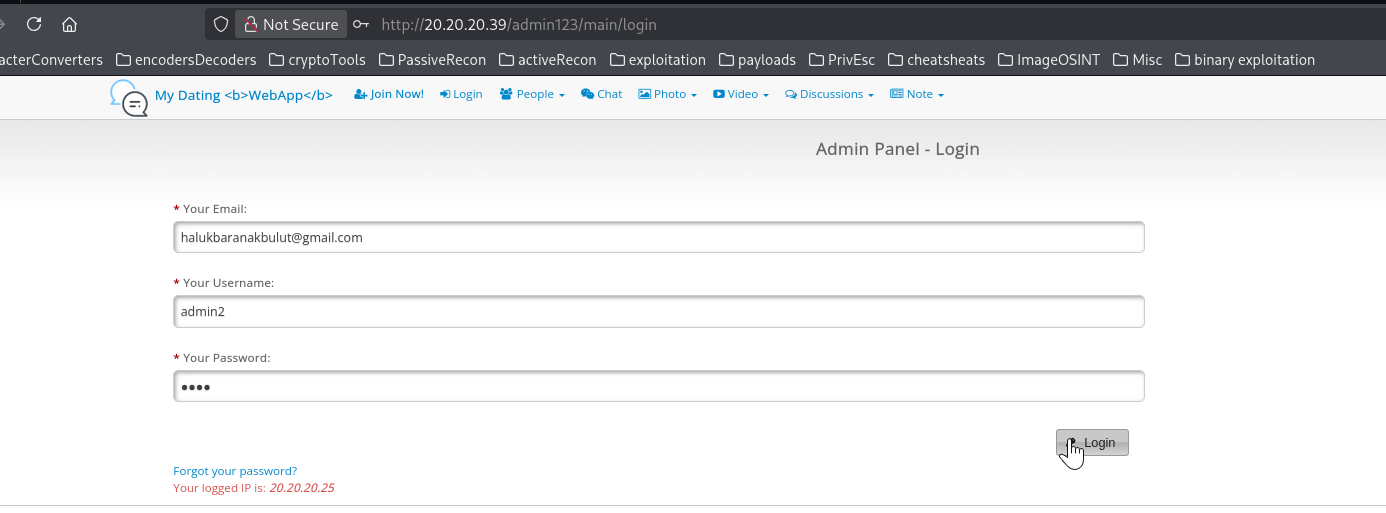
Figure 1: The admin login panel with an incorrect password submitted.
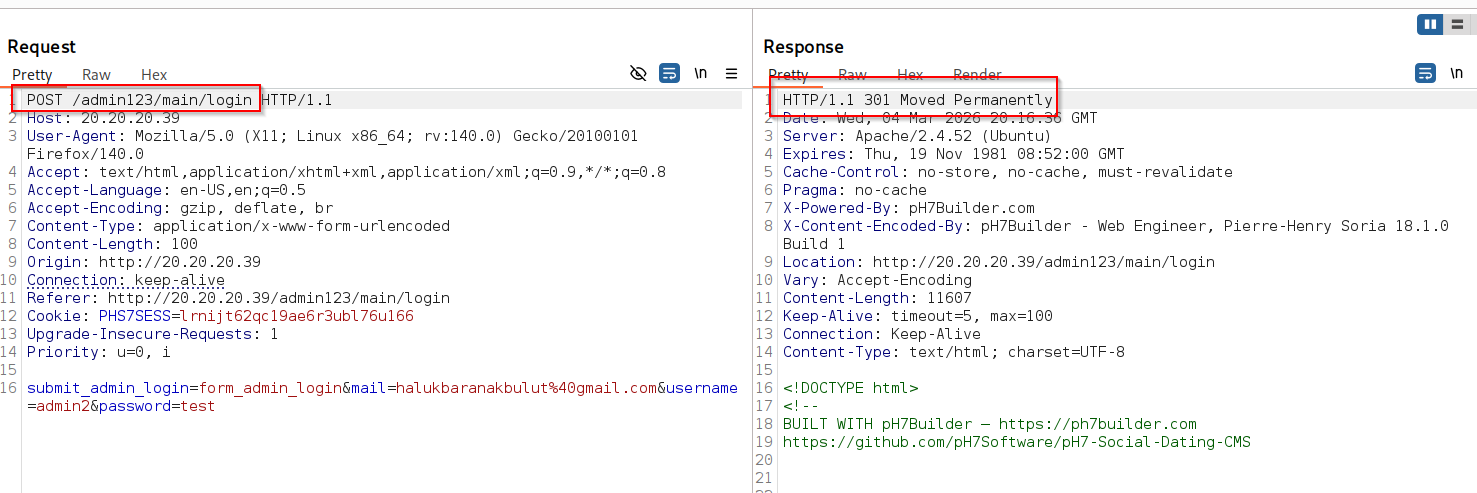
Figure 2: The intercepted POST and its 301 response.
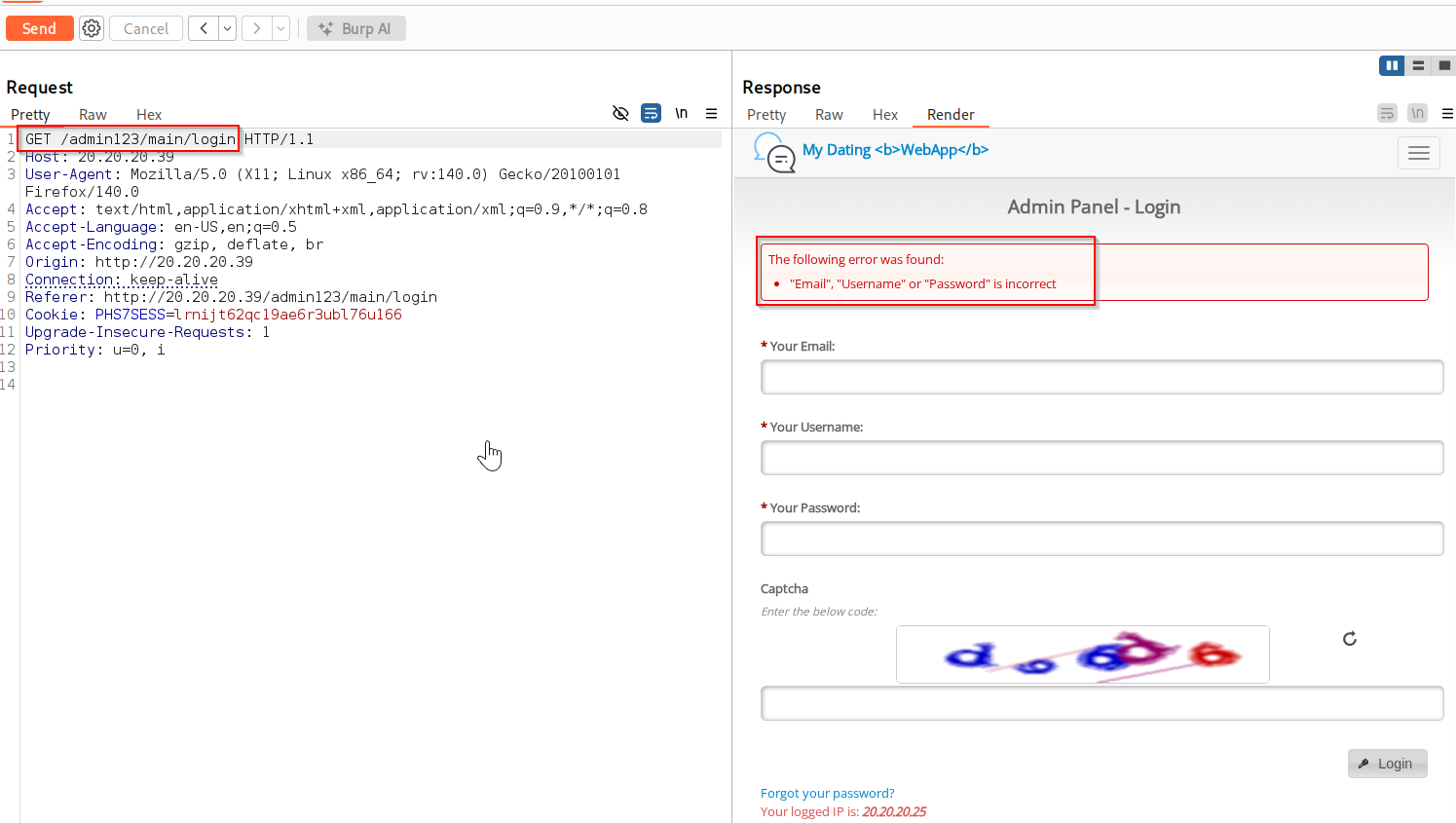
Figure 3: After following the redirect: the incorrect-password error.
Step 2 — expected CAPTCHA escalation under the same session:
Resending the identical request with the same PHS7SESS value produces a different outcome. The response no longer reports a password error. It reports a CAPTCHA error, because the session is now marked and the re-rendered form contains a CAPTCHA element.
The code of Captcha entered was incorrect. Please re-try.
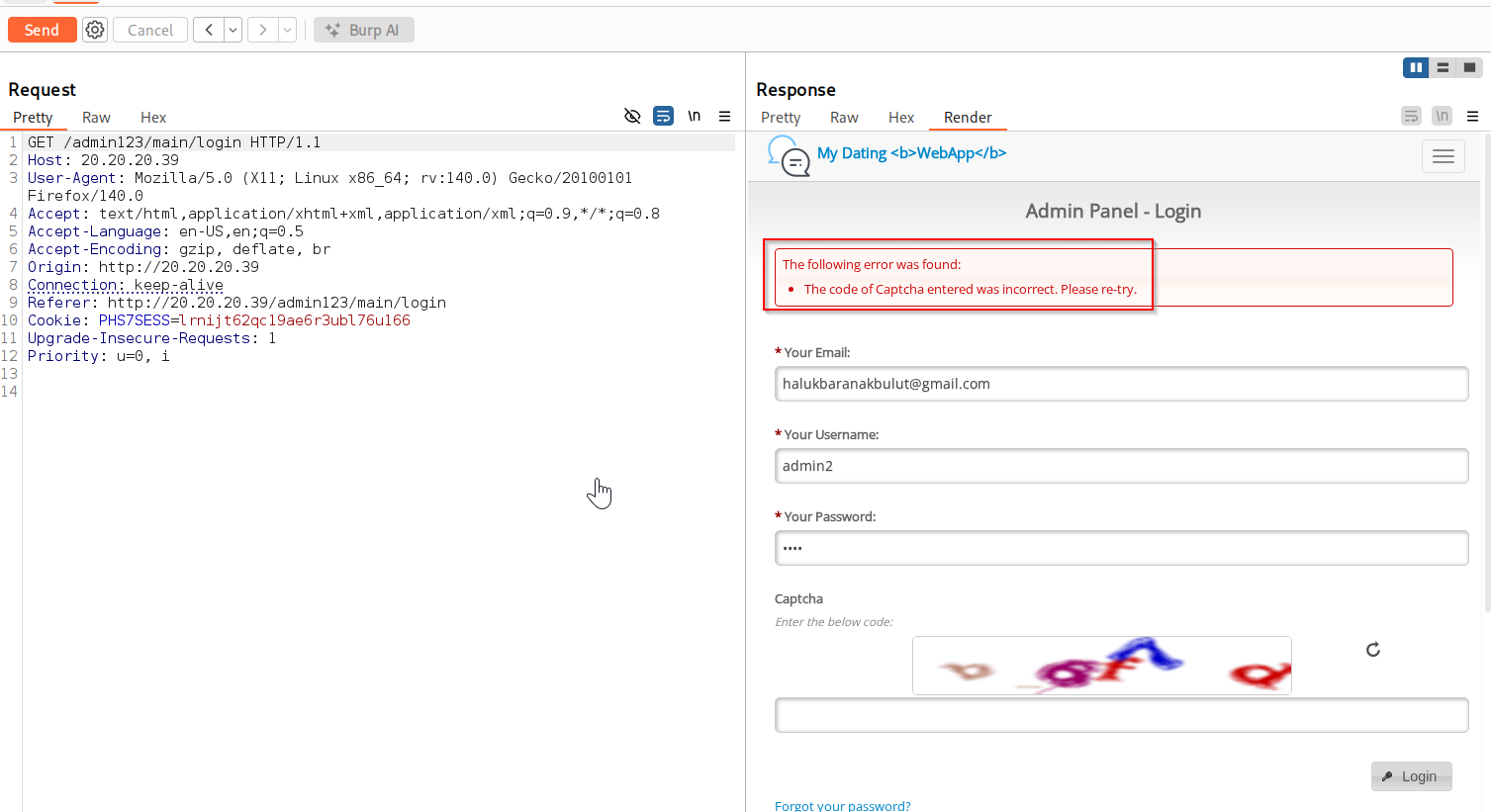
Figure 4: CAPTCHA validation triggered on the repeat attempt under the same session.
This step matters: it establishes that the defence is present and functioning, so that what follows is a bypass rather than a misconfigured target.
Step 3 — obtaining a fresh session:
GET /admin123/main/login HTTP/1.1
Host: TARGET_HOST
HTTP/1.1 200 OK
Set-Cookie: PHS7SESS=<S2>; path=/; HttpOnly; SameSite=Lax
With no Cookie header, the server starts a new session and returns a new PHS7SESS value, together with a freshly minted CSRF token in the form body.
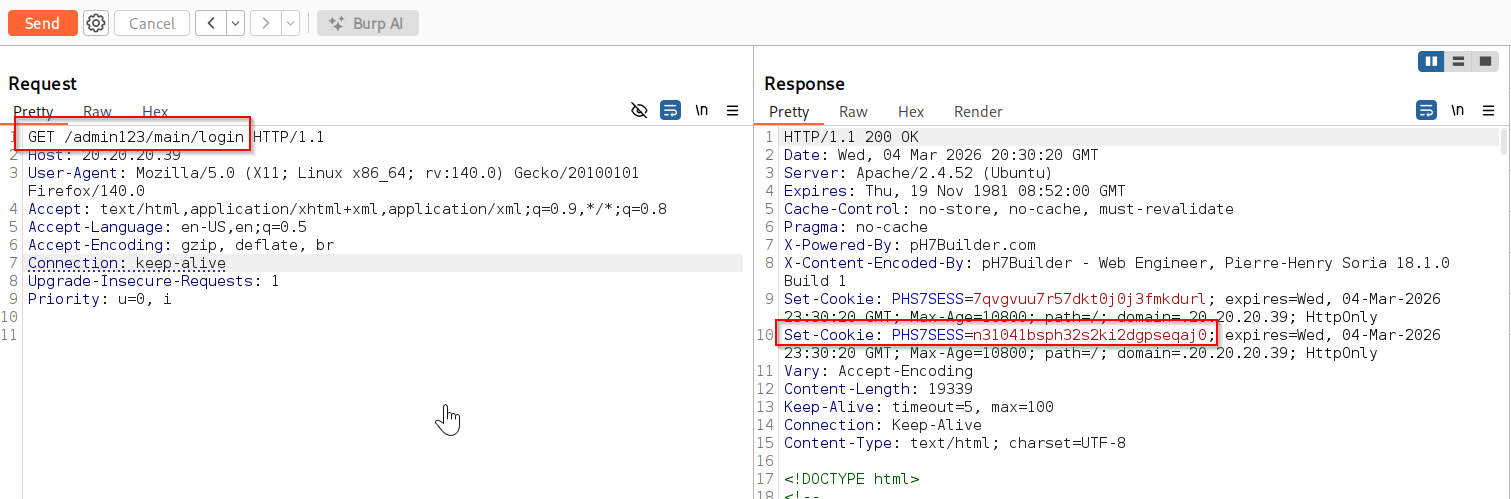
Figure 5: GET with the Cookie header removed; the server issues new PHS7SESS values.
Step 4 — the same guess under the new session:
POST /admin123/main/login HTTP/1.1
Host: TARGET_HOST
Cookie: PHS7SESS=<S2>
Content-Type: application/x-www-form-urlencoded

submit_admin_login=form_admin_login&security_token=<T2>&mail=admin%40TARGET_HOST&username=admin&password=<wrong>
The response is a 301 and, after following it, the standard “Email, Username or Password is incorrect” error. No CAPTCHA was presented, and no CAPTCHA value was submitted.
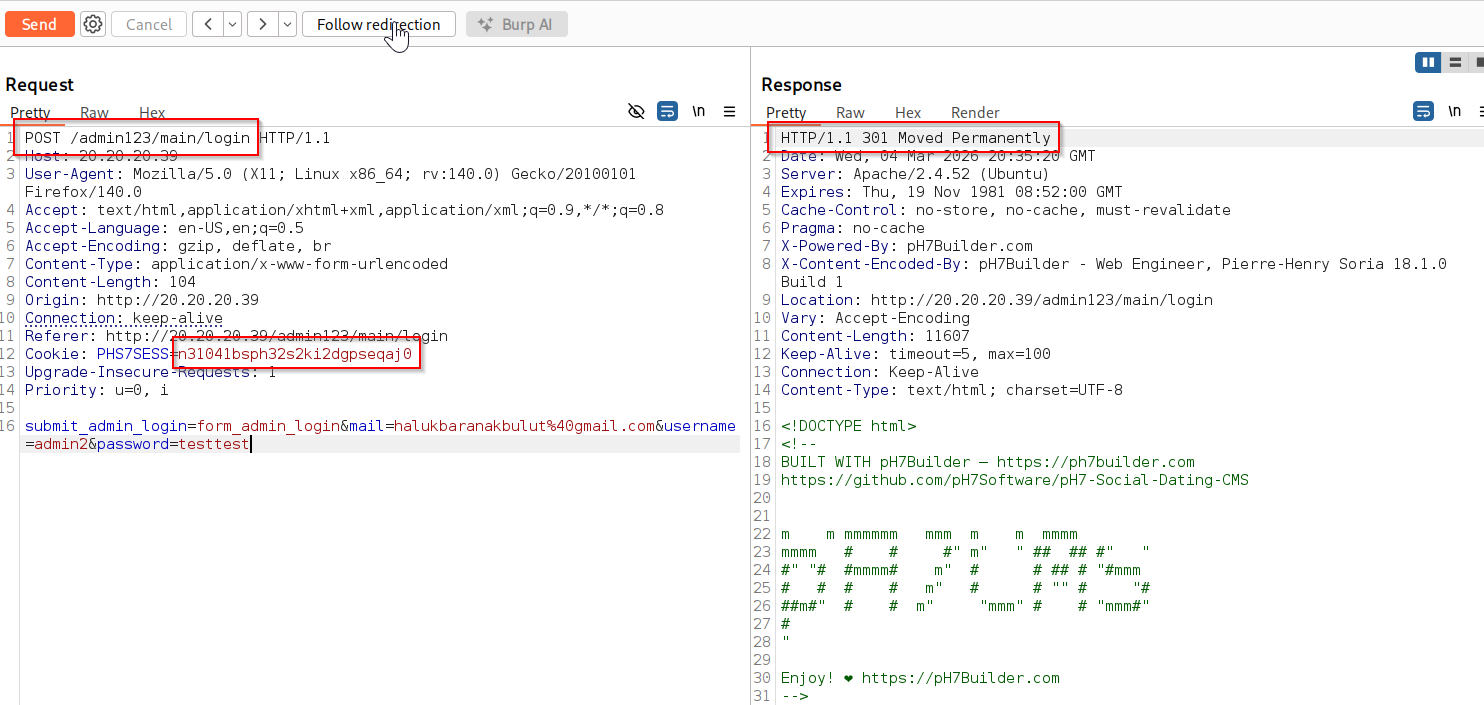
Figure 6: POST with the newly obtained session cookie.
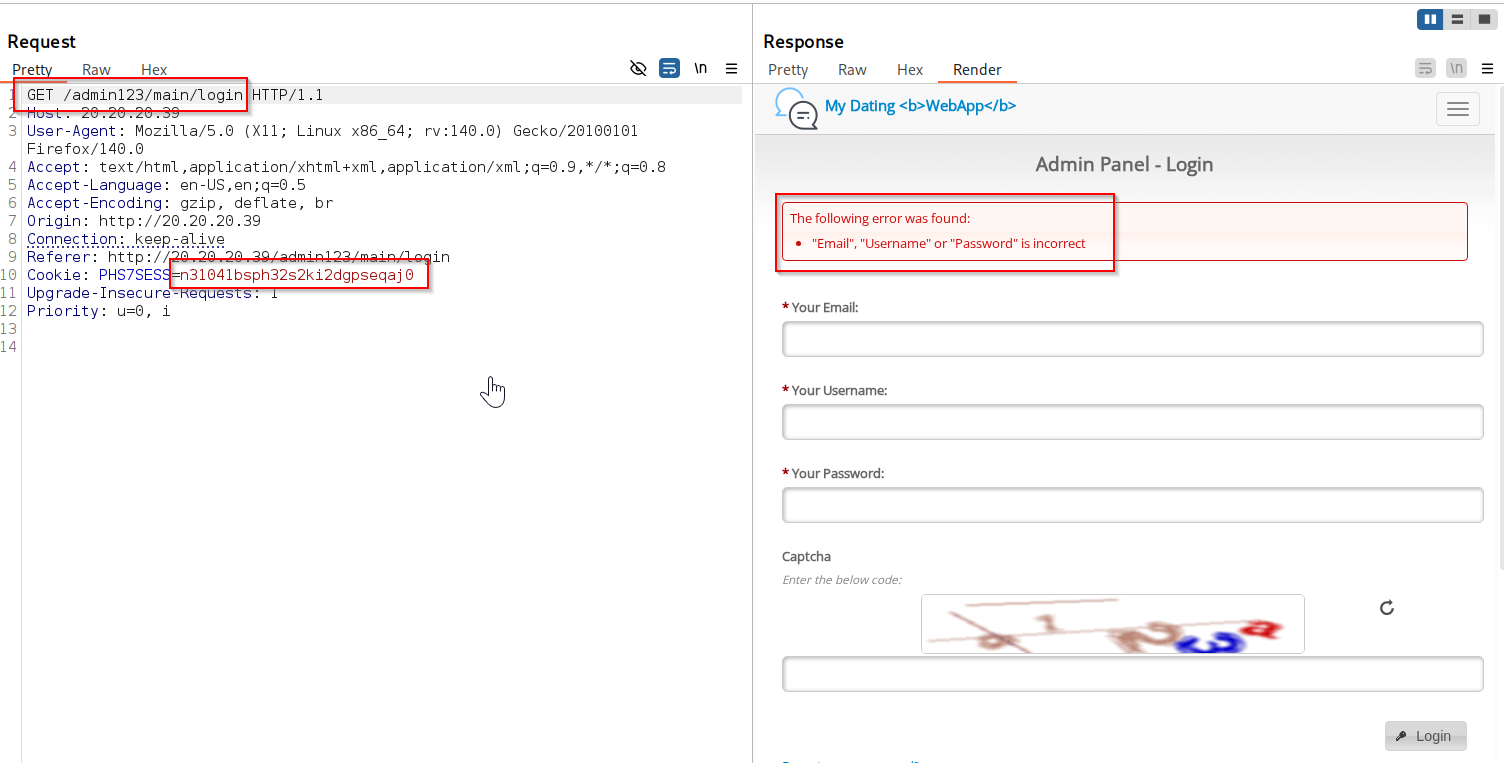
Figure 7: Challenge absent: only the credential error is returned.
Step 5 — confirming the authentication-success oracle:
Repeating Step 4 with the correct password produces a redirect to a different location. This is the oracle the automation relies on: a failed authentication redirects back to /admin123/main/login, while a successful one redirects to /admin123/main/index. The successful response also carries a new Set-Cookie, because the application regenerates the session identifier on login.
HTTP/1.1 301 Moved Permanently
Location: https://TARGET_HOST/admin123/main/index
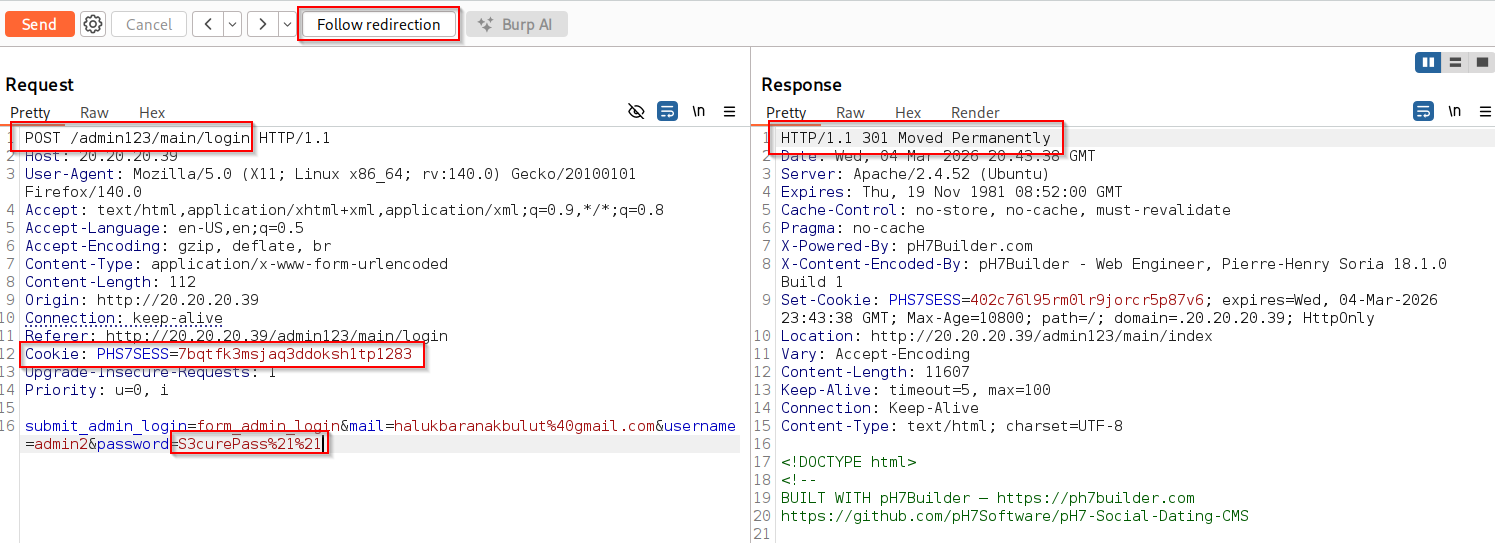
Figure 8: POST with a fresh session cookie and the correct password.
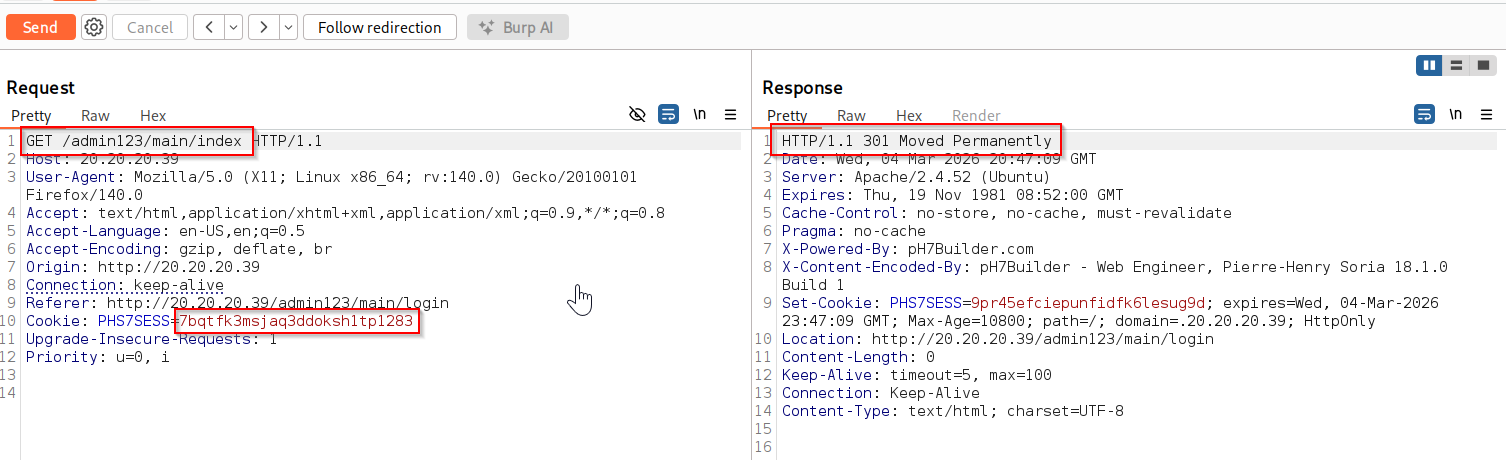
Figure 9: Following the redirect with the old session cookie returns to the login page rather than the admin panel.
Step 6 — reaching the IP lockout:
Continuing to guess with the session-reset technique alone eventually crosses the per-IP threshold. In this environment the lockout path returned a generic Internal Server Error page rather than the intended lockout message. The underlying cause was not investigated, since the observable effect of further attempts being refused was what mattered for the test.
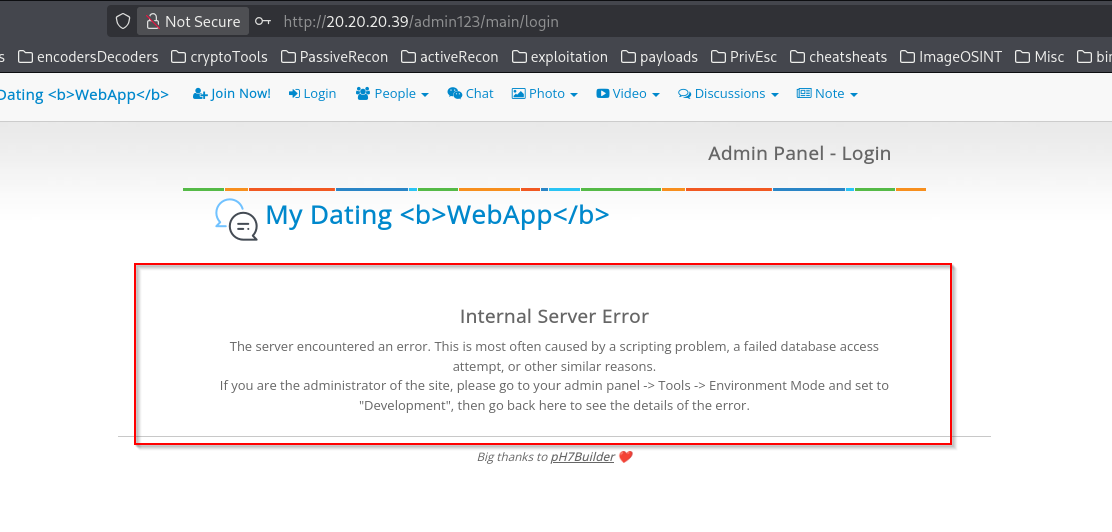
Figure 10: Requests refused after the per-IP threshold is crossed.
Step 7 — stepping around the lockout:
Adding a single header to the refused request, and to the GET that precedes it, restores normal processing:
X-Forwarded-For: 1.2.3.4
The response returns to the ordinary credential error, and the login page’s own footer, which prints the address the application believes it is talking to, displays the spoofed value.
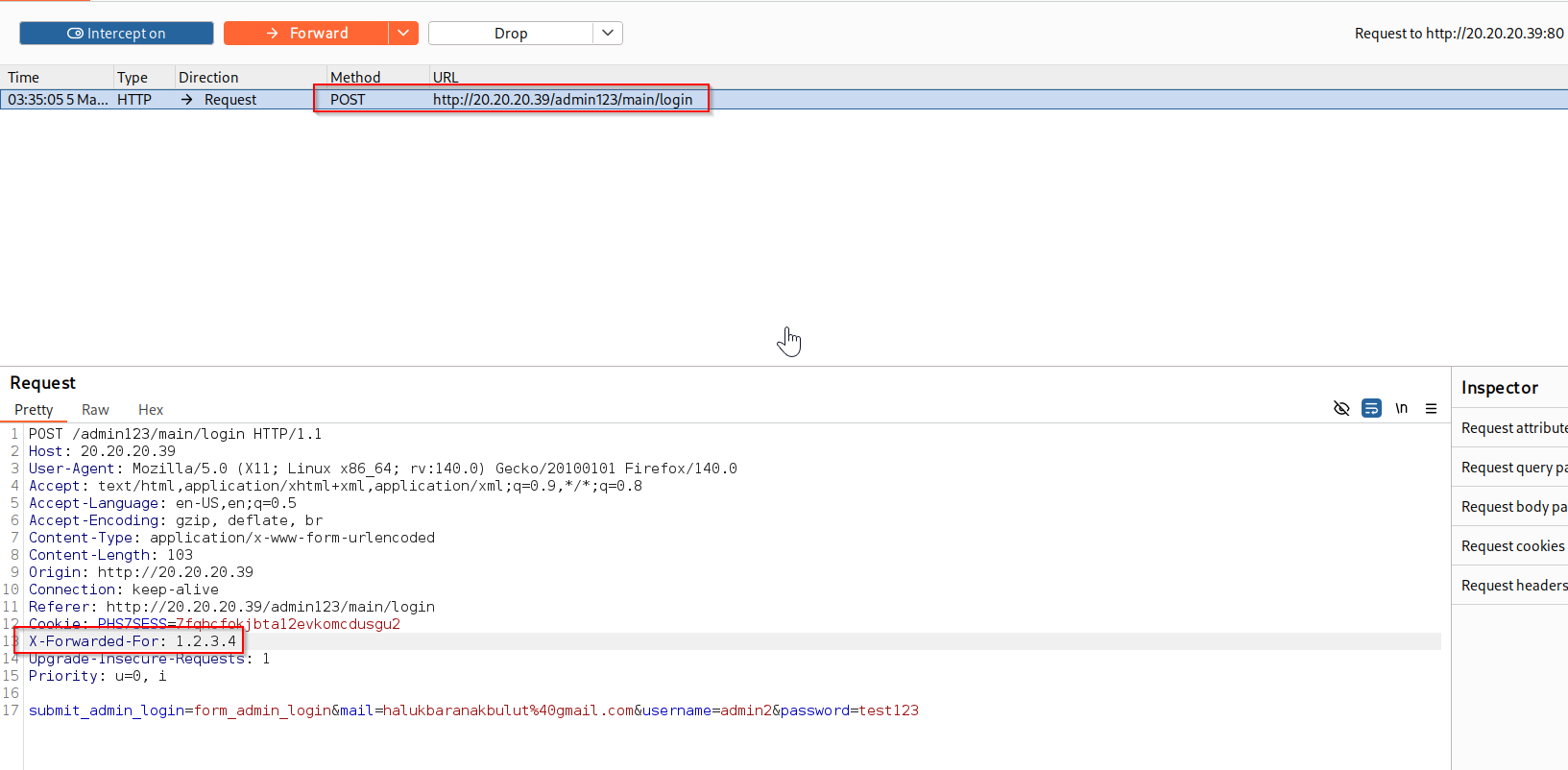
Figure 11: The spoofed X-Forwarded-For header added to the request.
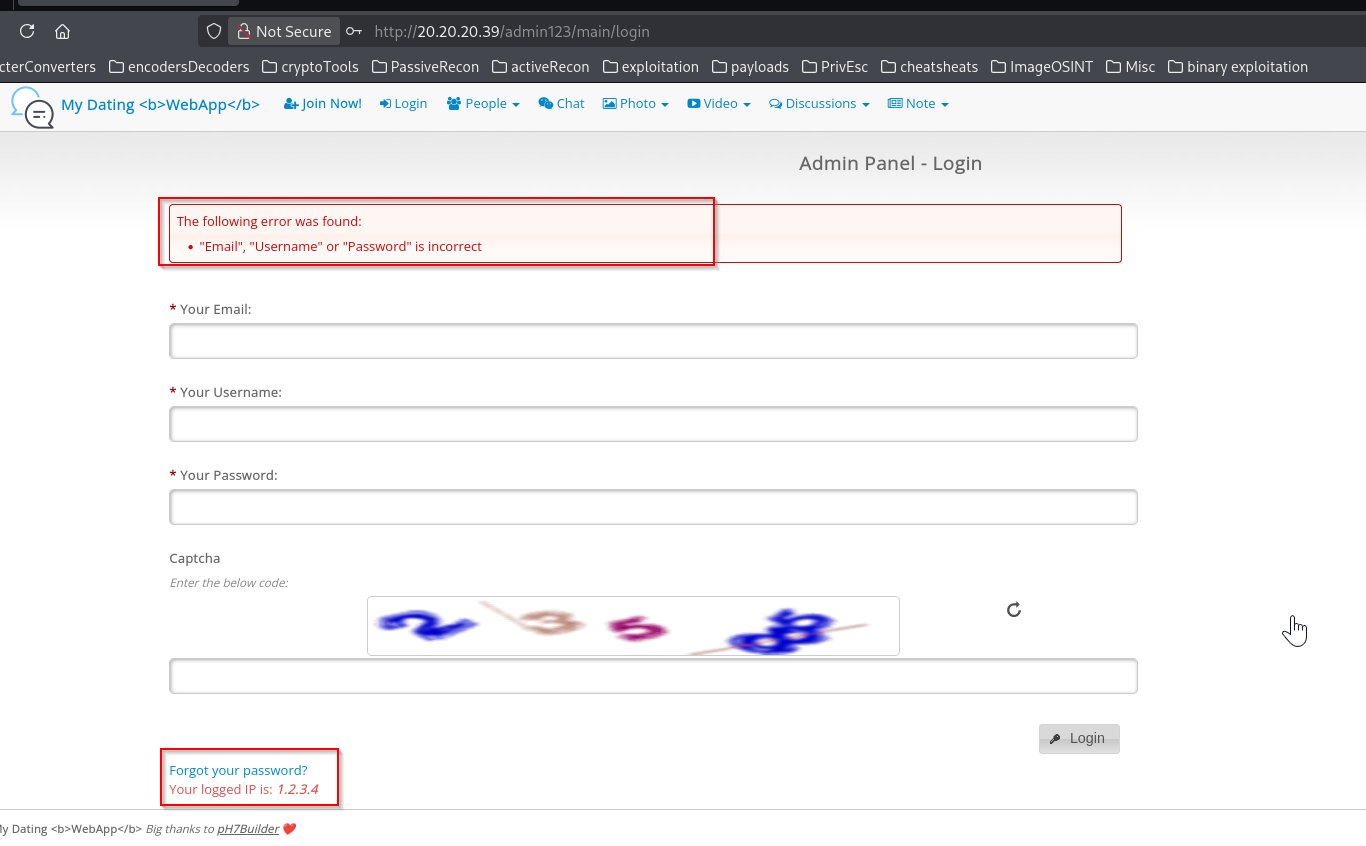
Figure 12: Lockout stepped around; the page echoes the spoofed address back.
That echo is the clearest single piece of evidence in the run: it confirms that the application accepted the attacker-supplied header value as its resolved client address.
Step 8 — the chain, automated: <details> <summary>Operating logic of the automation tooling</summary>
- Per-attempt setup. For each candidate password, generate one random public IPv4 address and send a
GETto the login URL with noCookieheader and that address inX-Forwarded-For, then take the issuedPHS7SESSvalue and the CSRF token from the response. - Guess.
POSTthe credentials using that session cookie, that CSRF token, and the sameX-Forwarded-Forvalue. The token is bound to the claimed address, so the pair must be consistent (see Section 10.1). - Oracle. Treat a
Locationheader pointing at/admin123/main/indexas success and a redirect back to the login page as failure, stopping on the first success. - Concurrency. Run the above in a small thread pool, which is what makes the per-failure server-side delay irrelevant (see below).
- Cleanup. Nothing is written to the target beyond the rows the application itself creates. The lab was restored from snapshot afterwards.
No weaponised tooling is published with this article. </details>
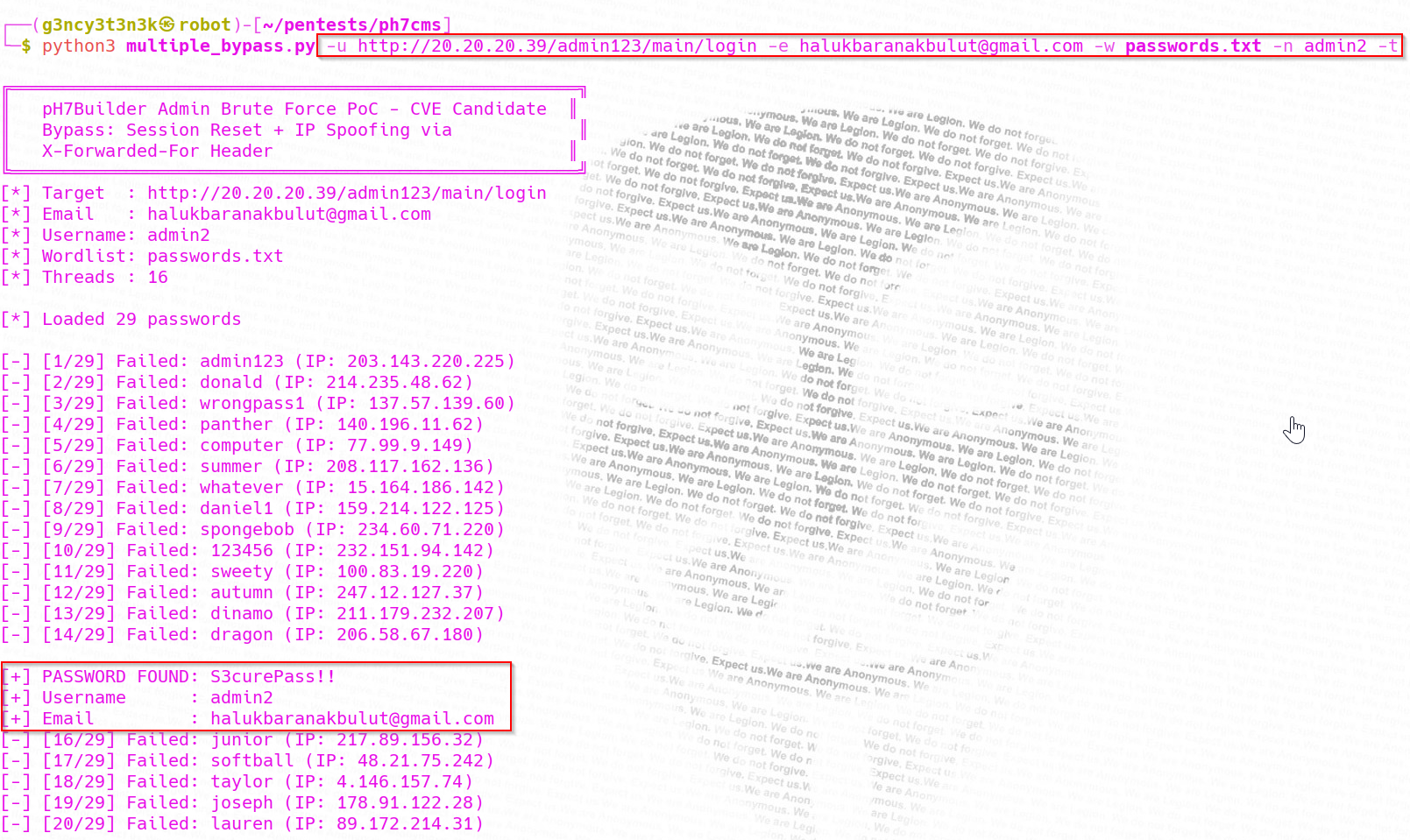
Figure 13: Automated run: the correct password recovered without any protection triggering.
In the recorded run the tool worked through a 29-entry wordlist using 16 threads and recovered the correct password at attempt 15, with no CAPTCHA presented and no lockout encountered.
Technical nuance: one throttle does survive both bypasses. A
sleep(2)on the failure path holds each failed request open for two seconds. It is a per-request delay rather than a per-attacker budget, so with 16 concurrent workers the fixed two-second cost is largely amortised across requests in flight rather than imposing two seconds of wall-clock time per candidate. Additional concurrency amortises it further, until server-side resource limits become the bottleneck. This is why the automation uses a thread pool at all: the delay is the only cost left once both links are in place. A delay throttles an attacker only when it is enforced against a key the attacker cannot multiply, which is the same property both links of this chain remove.
11.3 Patch Status and Regression Testing
The blueprint this article follows calls for the verification steps to be re-run against a patched build and shown to fail. That test is only partly available here, and the reason is itself part of the finding.
CVE-2026-37604 was fixed in release 18.3.0 (2026-06-08). getClientIp() was rewritten to consult forwarded headers only when the TCP peer appears in a $trustedProxies allowlist, defaulting to loopback addresses:
// _protected/framework/Ip/Ip.class.php (18.3.0 and later)

$trustedProxies = [
    '127.0.0.1', '::1',
    '::ffff:127.0.0.1',
    // Add your reverse proxy IPs here (e.g., Cloudflare, nginx, etc)
];

$remoteAddr = (string)Server::getVar(Server::REMOTE_ADDR, '');
$isTrustedProxy = in_array($remoteAddr, $trustedProxies, true);

$ipHeaderVars = $isTrustedProxy
    ? ['HTTP_CF_CONNECTING_IP', 'HTTP_TRUE_CLIENT_IP', 'HTTP_X_REAL_IP',
       Server::HTTP_CLIENT_IP, Server::HTTP_X_FORWARDED_FOR, Server::REMOTE_ADDR]
    : [Server::REMOTE_ADDR];
For a deployment where requests reach PHP directly, as in the configuration tested in Section 11.2, the source-level change appears to close Link 2 along the lines recommended in the report: a spoofed header from a non-loopback peer is ignored and the counter is keyed on the transport address again. The release carried no advisory and no changelog entry identifying it as a security fix.
Not lab-verified. The statements above are based on reading the vendor’s published source at release tags 18.2.0 and 18.3.0 and diffing them. The fix has not been re-tested in the laboratory, and the regression run the blueprint asks for is outstanding. Readers validating their own patching should reproduce Step 7 against 18.3.0 rather than take this on trust.
What the patch does not cover. CVE-2026-37603 is untouched. The CAPTCHA flag still lives in $_SESSION, and isCaptchaEligible() still reads only that flag, in every release through 19.2.0. On a patched build the session-reset technique still removes the challenge from the form; what now constrains the attacker is the per-IP counter, which on a direct-to-PHP deployment is finally doing its job. The practical result is a reduction from “no application-level limit” to “ten guesses per source address, with no challenge”, which is a real improvement but not a fix. Upgrading therefore closes one link of the chain and leaves the other in place.
12. Impact Analysis
| Dimension | Impact | Justification |
|---|---|---|
| Confidentiality | Low at the vulnerability level | The flaws disclose no data themselves; they remove the barrier between a remote attacker and an administrator password. A recovered password may then provide access to member records, messages, uploaded media, payment configuration and other functionality the panel exposes. |
| Integrity | Low at the vulnerability level | Likewise indirect: after successful authentication, the panel grants the content, account and configuration changes it is designed to grant. |
| Availability | None directly | Neither flaw causes service disruption by itself. The sustained request volume the attack requires may degrade a small installation, but that is a side effect rather than a capability. |
Both vectors assign Low impact to Confidentiality and Integrity and None to Availability, which reflects the flaws as scored in isolation: bypassing a throttle is not, by itself, a compromise. That framing understates the operational consequence and should not be read as a measure of urgency. What these flaws remove is the assumption every password policy quietly depends on, that an attacker gets a small, bounded number of attempts. Once the application’s own limits no longer apply, the security of the admin account rests on password strength alone.
Organisational risk: the administration panel of a dating and social platform is a concentration point for exactly the data that carries the highest regulatory weight: identity information, private messages, photographs, and in many deployments payment configuration. Depending on the data actually processed by a given deployment and on the legal framework that applies to it, compromise of an administrative account may expose personal data subject to obligations under frameworks such as Türkiye’s KVKK or the GDPR. Administrative access also carries the full set of privileges the panel is designed to grant, from settings and content to accounts and templates, so a recovered password is not a partial compromise of the platform but a complete one. A single weak or reused administrator password is the entire distance between “exposed endpoint” and that outcome.
Chaining potential: the two flaws in this article are already a chain, and the table below is the comparison that matters, not because either link is severe alone, but because the combination is what removes the last bound on the attack.
| Scenario | Requirements | Final impact |
|---|---|---|
| CVE-2026-37603 alone | Attacker limited to the addresses it actually controls | No challenge, but ~10 guesses per address per 120 minutes — slow, noisy, and survivable behind any competent password policy |
| CVE-2026-37604 alone | Attacker must solve or evade the CAPTCHA | Unlimited requests, but each one gated by a challenge — expensive to automate at scale |
| Both combined | None beyond network access | Unchallenged password guessing with no application-level limit, each attempt recorded under a distinct spoofed source address; success becomes a function of wordlist quality alone |
The wider lesson generalises past this product. Two findings rated Medium, each reasonably scored, compose into an outcome that neither vector describes, because CVSS scores a flaw while an attacker exploits a system. This illustrates a limitation of evaluating chained vulnerabilities solely by their individual base scores: the combined attack path can carry materially greater operational impact than either score suggests.
13. Detection and Log Analysis
Network and application layer:
- A
GET/POSTpair per credential guess, with a new session each time. The chain’s signature is structural rather than payload-based: in the demonstrated attack flow each credential guess is preceded by a cookie-lessGETto the login URL, so the ratio of sessions issued to login attempts approaches 1:1. Legitimate use produces one session and many requests. This produces one session per request.# GET vs POST volume on the login endpoint, per source. A ratio approaching 1:1 # from a single source is the structural indicator; normal use is GET-light. awk '$7 ~ /admin123\/main\/login/ {gsub(/"/, "", $6); print $1, $6}' /var/log/apache2/access.log \ | sort | uniq -c | sort -rn | head -40The cookie-less property of thoseGETrequests is not visible in the default combined log format, which records no request headers. Confirming it requires logging the inboundCookieheader or the outboundSet-Cookie, as in the format below. - High cardinality of
X-Forwarded-Forvalues against a singleREMOTE_ADDR. This is the strongest available indicator, and it is only visible where the transport address and the claimed address are logged side by side. A large number of distinct public claimed addresses associated with one transport source is highly suspicious and should be investigated as potential header spoofing. Benign causes such as a misconfigured intermediary exist, but they do not normally produce a distinct value per request.# Log both, so the two can be compared at all. # %{c}a is the connection peer, %{X-Forwarded-For}i is what the client claimed. LogFormat "%{c}a %{X-Forwarded-For}i %t \"%r\" %>s %b" xff_transport%{c}ais used rather than%adeliberately. Wheremod_remoteipis active,%aalready reflects the rewritten client address, which is the value under the attacker’s control.%{c}apreserves the underlying connection peer, and the comparison only works if both are recorded. - A burst of 301 responses to
/admin123/main/loginwith no successes. Failed and successful logins both redirect, so status codes alone do not separate them. TheLocationtarget does. A concentration of redirects back to the login page, ending in a single redirect to/admin123/main/index, is the attack succeeding.
Host and database layer (SIEM / audit):
ph7_admins_attempts_loginfilling with single-attempt rows. Under normal operation this table holds a handful of rows with rising counters. Under this attack it accumulates one row per guess, nearly all withattempts = 1and timestamps seconds apart. A count of rows created per minute is a cheap, high-signal query.SELECT COUNT(*) AS rows_created, MIN(lastLogin), MAX(lastLogin) FROM ph7_admins_attempts_login WHERE lastLogin > NOW() - INTERVAL 1 HOUR;ph7_admins_log_loginrecording addresses that never connected. Because CVE-2026-37604 places the resolved address under the client’s control, the addresses this table stores are the ones the client claimed. On an affected version, do not treat them as the source of an attempt: correlate against the web server’s transport-level log instead, and read disagreement between the two as the indicator.
Detection indicators:
| Type | Value | Notes |
|---|---|---|
| URI pattern | /admin123/main/login | Default admin path; a renamed path changes this but not the pattern |
| Request pattern | Cookie-less GET immediately followed by a login POST using the newly issued session, repeated | The structural fingerprint of the demonstrated flow |
| Header anomaly | Many distinct, well-formed public X-Forwarded-For values from one REMOTE_ADDR | Only detectable if both are logged |
| Success marker | Location: /admin123/main/index following a run of failures | The moment the attack succeeded |
| Database anomaly | High row-creation rate in ph7_admins_attempts_login with attempts = 1 | Distinguishes this attack from ordinary repeated failures |
Limits of detection: every indicator above depends on observing the transport-level source address. An attacker who distributes the same attack across a proxy pool or botnet, rather than spoofing a header from one connection, produces traffic that is not structurally distinguishable from many unrelated visitors failing to log in, and the header-correlation rule finds nothing because each claim matches its connection. Detection then falls back to the aggregate: total failed administrative logins per unit time, regardless of source. Equally, an installation that logs only
X-Forwarded-Foras the client address, a common reverse-proxy configuration, has no ground truth to correlate against and cannot detect this attack from its own logs at all.
14. Remediation and Secure Coding Lessons
Permanent fix:
- Upgrade to 18.3.0 or later. This closes CVE-2026-37604 for deployments where PHP is reached directly, by keying the counter on the transport address again. It does not close CVE-2026-37603, and Section 11.3 describes what it leaves open for proxied deployments.
- No vendor fix exists for CVE-2026-37603. Until one does, the compensating controls below are the available response, and the first of them is the one that matters.
Compensating controls (where patching is not sufficient or not immediately possible):
- Enforce rate limiting outside the application, keyed on the transport address. A reverse proxy or WAF rule on the admin login path, such as nginx
limit_reqkeyed on$binary_remote_addror fail2ban reading the web server access log, is the only control here that an attacker cannot re-key, because it never consults a request header. Does not cover: distributed guessing from many real source addresses. - Enable two-factor authentication for administrator accounts. pH7Builder supports it, and it breaks the chain at the point where a correct password would otherwise become a session. Does not cover: the guessing itself. The attacker still learns the password, which matters wherever it has been reused.
- Restrict the admin panel at the network edge. An IP allowlist in the web server, a VPN requirement, or client-certificate authentication in front of
/admin123/removes the attack surface outright. Does not cover: nothing, provided the restriction is enforced at the edge on the transport address rather than inside the application. - Rename the administration path. Raises the cost of discovery. Does not cover: anything once the path is known, which it will be for any installation that has ever exposed it. Treat this as noise reduction, not as a control.
- Set a long, unique administrator password now, and confirm the account’s own history. With guessing unbounded, entropy is the only remaining bound. Does not cover: a password already recovered before the control was applied, which is why the log review in Section 13 should be done before, not after.
Defence matrix:
| Control | Link it breaks |
|---|---|
| Upgrade to ≥ 18.3.0 (direct-to-PHP deployment) | Link 2 — the counter key becomes the transport address |
Edge rate limiting on REMOTE_ADDR | Link 2, independently of the application version |
| Server-side per-account attempt tracking | Link 1 — the challenge no longer depends on which session is presented |
| Two-factor authentication | Neither link; breaks the path from a recovered password to a session |
| Network-level access restriction | Both, by removing reachability |
14.1 Secure Coding Lessons
1) A throttle must be keyed on the resource it protects, not on the conversation:
// Vulnerable pattern — state lives where the client can renew it
$this->session->set('captcha_admin_enabled', 1);
if ((new Session)->exists('captcha_admin_enabled')) {
    $form->addElement(new Captcha(/* ... */));
}

// Safe pattern — state lives with the account, and the check precedes evaluation
$attempts = $store->failedAttemptsFor($username, $windowMinutes);   // server-side, keyed on the target
if ($attempts >= self::CHALLENGE_THRESHOLD && !$challenge->verify($request)) {
    return AuthResult::challengeRequired();   // fails closed; no element to omit
}
The structural difference is not the storage backend but the direction of the dependency: the safe version asks the account how many times it has been attacked, the vulnerable version asks the attacker.
2) Read the client address from the transport, and trust headers only from peers you named:
// Vulnerable pattern
$ip = $_SERVER['HTTP_CLIENT_IP']
   ?? $_SERVER['HTTP_X_FORWARDED_FOR']
   ?? $_SERVER['REMOTE_ADDR'];

// Safe pattern
$ip = $_SERVER['REMOTE_ADDR'];
if (in_array($ip, $trustedProxies, true)) {
    // walk the chain from the RIGHT, discarding hops you trust,
    // and stop at the first address a trusted hop did not contribute
    $ip = self::rightmostUntrusted($_SERVER['HTTP_X_FORWARDED_FOR'] ?? '', $trustedProxies) ?? $ip;
}
Parsing direction is not a detail. In a forwarded chain the leftmost entry is the one the original client wrote and each trusted hop appends to the right, so reading the list left to right hands the key back to the client even when the allowlist itself is correct.
3) Controls must fail closed, and be verifiable when they do:
A challenge that is conditionally constructed can be omitted. A challenge that is unconditionally verified can only be passed or failed. Where a control is built into a form at render time, its absence is indistinguishable from its success, which is why the flaw in Section 9 survives casual testing. Write the check so that the only way past it is to satisfy it, then confirm it by asserting on the negative case rather than the positive one. The question to ask of any throttle under review is the shortest one available: what value is this keyed on, and can the client change it?
15. Real-World Context
- Bludit ≤ 3.9.2 (CVE-2019-17240):
bl-kernel/security.class.phpcounted failed logins against an address taken fromX-Forwarded-For, so supplying a different value per request bypassed the lockout entirely. Public exploits followed quickly, and the flaw became a standard teaching example of the class. - Keycloak ≤ 24.0.3 (CVE-2024-4629): brute-force protection validated the attempt count before the account was locked, so a burst of parallel login attempts obtained more guesses than the configured threshold permitted, the same outcome as Section 11.2’s thread pool reached by a different route.
- Ghost (CVE-2024-34451): multiple
X-Forwarded-Forheaders with differing values circumvented login rate limiting. The advisory was later revoked on the argument that the fault lay in proxy configuration rather than the application. That dispute is worth noting here, because pH7Builder’s own fix resolves the same question by handing the trust decision to the deployer.
The pattern across these is not that developers forget to rate-limit. All three products had a throttle, implemented deliberately, with sensible thresholds. What they shared is a key the attacker could choose, a header in two cases and a scheduling gap in the third. A key the attacker can choose turns a rate limiter into an accountant: it records the attempts faithfully and prevents none of them. The exploit primitive this class yields is unbounded retries against any check that assumes it will only be run a few times, which is a far larger surface than login forms alone: password reset codes, one-time passwords, coupon and voucher redemption, API keys, and email verification tokens are all defended primarily by the assumption that guessing is expensive.
16. Conclusion
Two independently reported flaws in pH7Builder’s administration login combine into an unauthenticated, unbounded password-guessing attack against administrator accounts. Neither is exotic: one stores escalation state in the client’s own session, the other reads the client’s address from a header the client writes. The root cause is the same in both, and it is not a missing control but a mis-keyed one. In each case the application asked the attacker which bucket to count them in. As of this writing the header flaw has been fixed upstream, silently, in release 18.3.0. The session flaw has not been fixed at all.
- A rate limiter is only as good as its key. Thresholds, backoff curves and lockout windows are refinements on top of one decision that has to be right first: what value groups these requests together, and can the requester change it? Every other parameter is tuning.
- An unauthenticated client can hold as many sessions and claimed addresses as it asks for. Sessions are issued on request, forwarded headers are free to assert, and both are free to discard. Any pre-authentication control that stores its memory in either has, in practice, no memory at all.
- Two Mediums compose into something neither vector describes. CVSS scores a flaw in isolation, and it does so correctly here. It has no mechanism for expressing that these two remove the same bound from opposite sides. Chained findings therefore warrant assessment as a path, not only as a pair of base scores.
- Silent patching reduces defenders’ ability to judge urgency. The fix in 18.3.0 is a real improvement, but shipped without an advisory, a changelog entry, or a CVE reference it gave administrators no basis on which to prioritise the upgrade, and upgrade-averse installations are still running without it.
- Go and check what your own throttles count. Find every failed-attempt counter, lockout, and challenge-escalation flag in code you own, and for each one, write down the expression that produces its key. If that expression is derived from a client-controlled value such as a cookie, a session or a request header, the control should be reviewed for this class of rate-limit bypass before anyone else reviews it for you.
17. References
Official records
- MITRE — CVE-2026-37603: https://www.cve.org/CVERecord?id=CVE-2026-37603 (reserved, record may not yet be populated)
- MITRE — CVE-2026-37604: https://www.cve.org/CVERecord?id=CVE-2026-37604 (reserved, record may not yet be populated)
- CWE-307 — Improper Restriction of Excessive Authentication Attempts: https://cwe.mitre.org/data/definitions/307.html
- CWE-290 — Authentication Bypass by Spoofing: https://cwe.mitre.org/data/definitions/290.html
- CVSS v3.1 calculator: https://www.first.org/cvss/calculator/3.1
- MITRE ATT&CK T1110 — Brute Force: https://attack.mitre.org/techniques/T1110/
Vendor
- pH7Builder repository: https://github.com/pH7Software/pH7-Social-Dating-CMS
- Affected source, 18.1.0 —
Ip.class.php: https://github.com/pH7Software/pH7-Social-Dating-CMS/blob/v18.1.0/_protected/framework/Ip/Ip.class.php - Fix comparison, 18.2.0 → 18.3.0: https://github.com/pH7Software/pH7-Social-Dating-CMS/compare/v18.2.0…v18.3.0
- Current source —
LoginForm.php(CAPTCHA state, still session-bound): https://github.com/pH7Software/pH7-Social-Dating-CMS/blob/master/_protected/app/system/modules/admin123/forms/LoginForm.php - Vendor security policy (added in 18.5.0): https://github.com/pH7Software/pH7-Social-Dating-CMS/blob/master/SECURITY.md
Public exploit status
- No exploit tooling is included with this publication. The article publishes request/response detail and the operating logic of the researcher’s own lab automation, but not the automation itself (see Section 2). No public exploit for either CVE was known to the researcher at the time of publication.
Prior art in the same class
- Bludit brute-force mitigation bypass (CVE-2019-17240): https://www.cvedetails.com/cve/CVE-2019-17240/
- Keycloak brute-force protection bypass (CVE-2024-4629): https://bugzilla.redhat.com/show_bug.cgi?id=2276761
- Ghost rate-limit bypass via multiple XFF headers (CVE-2024-34451, advisory later revoked): https://security.snyk.io/vuln/SNYK-JS-GHOST-7266556
Technical guidance
- OWASP — Blocking Brute Force Attacks: https://owasp.org/www-community/controls/Blocking_Brute_Force_Attacks
- OWASP — Authentication Cheat Sheet: https://cheatsheetseries.owasp.org/cheatsheets/Authentication_Cheat_Sheet.html
- OWASP — Proxy Header Security Cheat Sheet: https://cheatsheetseries.owasp.org/cheatsheets/Proxy_Header_Security_Cheat_Sheet.html
- NIST SP 800-63B (Revision 4), Digital Identity Guidelines: Authentication and Lifecycle Management. See §3.2.2, “Rate Limiting (Throttling)”: https://pages.nist.gov/800-63-4/sp800-63b.html
Appendix A — Glossary
| Term | Definition |
|---|---|
| CVE-2026-37603 | Improper restriction of excessive authentication attempts (CWE-307) in the pH7Builder admin login: the CAPTCHA escalation flag is stored in the PHP session, so a fresh session removes the challenge. |
| CVE-2026-37604 | Authentication bypass by spoofing (CWE-290) in Ip::get(): the client address used to key the login-attempt counter is read from request headers. |
PHS7SESS | The PHP session cookie name shipped in pH7Builder’s installer configuration; the key under which the CAPTCHA escalation flag is stored. |
Ip::get() / getClientIp() | The framework helper resolving the client address; the single point at which the rate-limit key for the admin login is decided. |
captcha_admin_enabled | The session key whose presence causes the CAPTCHA element to be built into the admin login form. |
ph7_admins_attempts_login | The per-address failed-attempt counter table consulted before credentials are evaluated. |
| Session reset | Discarding the session cookie and requesting a new one before each attempt, so that per-session escalation state never accumulates. |
| Rate-limit key | The value a throttle groups requests under. Where the requester can choose it, the throttle records attempts without restraining them. |
About the author
Haluk Baran Akbulut
Administrator
Subscribe to the newsletter
New cybersecurity articles, research and hardware-lab notes — straight to your inbox.
Related articles
CVE-2026-25769 Analysis: Remote Code Execution in Wazuh Cluster via Insecure Deserialization

CVE-2026-31431 Technical Analysis: The “Copy Fail” Local Privilege Escalation Vulnerability in the Linux Kernel